
By Awan Achiek
South Sudan is grappling with escalating food insecurity as a prolonged dry spell devastates crops, depletes water sources, and threatens rural livelihoods. Farming communities, heavily reliant on rain-fed agriculture, are increasingly anxious about dwindling food supplies and incomes.
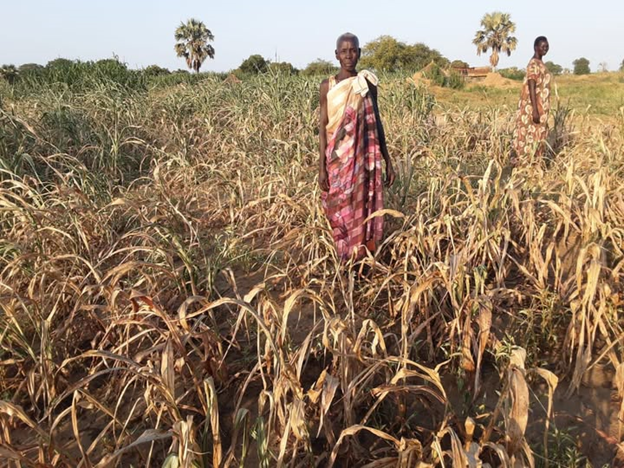
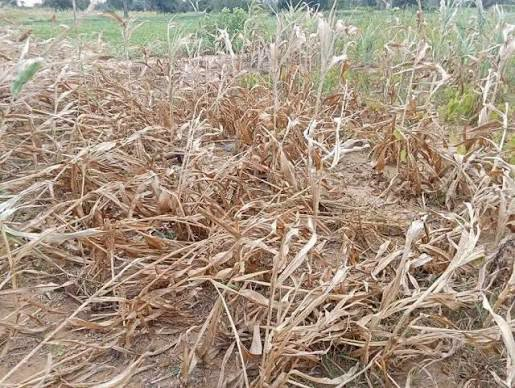
Yel Yel Kuol, executive chief of Malual-Baai Payam in Aweil East County, Northern Bahr el Ghazal, highlighted the dire situation. “The crops we planted have dried up. I don’t know how we are going to survive,” Kuol told The Dawn, standing in his withered fields.
“Crops have dried up in Rum-wel and Majak, while those in Tiit-Ubiet have also withered. Only the cows are now roaming the farms.”
Kuol reported an abnormal rainfall pattern this year, with long rains ceasing in May instead of continuing through the traditional April-May rainy season.
“I have never experienced such a disaster since I was born or since I became the executive chief of this area. All the crops we planted have dried up, and people are now walking through the farms during what should be the rainy season,” he said.
“I don’t know how we are going to survive this year. Even the water sources have dried up, and the cows have no water to drink.”
Dominic Maring, a farmer from Tali Payam in Terekeka County, Central Equatoria State, described widespread crop losses that have left many residents devastated.
“Even if it rains now, there is little hope because the crops we planted have already been damaged. We no longer know what to do. Hunger is looming,” Maring said.
Agriculture is a primary source of food and livelihoods for South Sudanese households, making reliable rainfall crucial for the country’s food supply.
Humanitarian agencies have repeatedly warned that millions in South Sudan remain vulnerable to hunger and malnutrition, particularly in areas affected by conflict, displacement, and climate shocks.
The persistent dry spell is raising concerns that declining agricultural production could deepen existing food insecurity and increase humanitarian needs in the coming months.
Martha Ajok, a farmer in Awerial County, Lakes State, noted that her area has experienced crop failure for a year.
“We cultivate maize and groundnuts, but everything has dried up. If you go to the gardens now, you will find the groundnuts completely dried out, and in some cases, you cannot even uproot them,” Ajok said.
She added that the withering of crops has left farmers struggling to secure seeds for the next planting season.
“What worries us is not only what we will eat, but also where we will get seeds for next year. We cannot get seeds from these crops because they have all been destroyed.”
John Parac Atholueth, Coordinator of the Awerial County Relief and Rehabilitation Commission (RRC), said a rapid assessment conducted between June 20 and 24, 2026, across the county’s six payams and 21 bomas, found that crops had been severely affected by a prolonged dry spell.
Parac reported that below-average rainfall for the last four months has left 65,040 host community members and 79,639 internally displaced persons without adequate food, raising fears of a humanitarian crisis if urgent assistance is not provided.
“Awerial County is currently facing catastrophic meteorological drought, below-average rainfall, and extended dry spells of four years. In 2026, it has severely disrupted local agriculture,” he said.
Parac stated that the combined impact of widespread crop failure and the influx of internally displaced persons (IDPs) from Jonglei State has pushed 99,809 people into hunger.
“This total includes 65,041 host community members and 79,639 internally displaced persons in major settlements in Mingkaman, Marik, Gakaror, Maraya, and Yolakot,” he said.
Jok Madut Jok, a South Sudanese scholar and public policy expert, urged the government to strengthen early-warning systems, support affected farmers and livestock keepers, and ensure timely assistance reaches communities at risk.
“I also checked to see if the Famine Early Warning System (FEWS) was still publishing data predicting famines, and I was shocked to find that it has also shut down for South Sudan, Somalia, and Eritrea,” Madut said.
Madut warned that the country will face what he called a “really tough food situation” going forward, starting with the currently failing harvest.
“If nothing is done to prepare for disastrous food deficits in a country where the majority of people do not have any purchasing capacity to use markets.”
Clement Juma Mbugoniwia, Minister of Agriculture and Food Security, said the government is working to mobilize resources and coordinate emergency response efforts with UN partners.
He said the plan aims to mitigate the impact of the prolonged dry spell on vulnerable communities while protecting agricultural livelihoods and strengthening food production across the country.
“South Sudan sees drought as a global issue that must be faced jointly by the United Nations, not by countries alone. This was the position of South Sudan and African countries throughout the just-concluded UNCCD COP17 in Ulaanbaatar.”


Join the conversation
Keep contributions respectful, relevant and suitable for a public newsroom.