
By Simon Deng
South Sudanese entrepreneurs are calling on national and state governments to overhaul the country’s business environment, warning that burdensome regulations and a weak legal framework are stifling local enterprises, hindering job creation, and slowing economic growth.
This appeal was made on Saturday by business leaders who emphasized that small and medium-sized enterprises (SMEs) require stronger policy support and investor-friendly regulations to thrive and contribute to a sustainable economy.
Angelo Ngot Mayar Kuot, chairperson of the Twic Community in Juba, highlighted the need for a supportive regulatory framework to boost livelihoods, create jobs, and foster a sustainable economy.
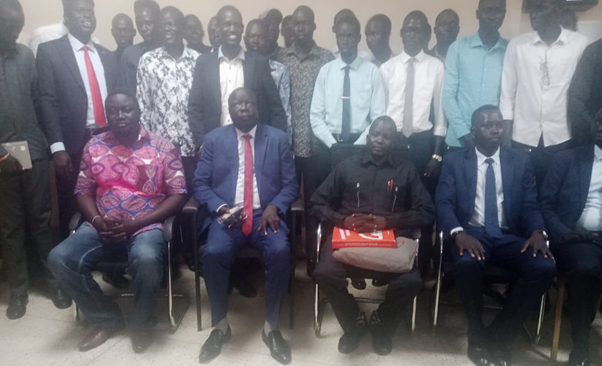
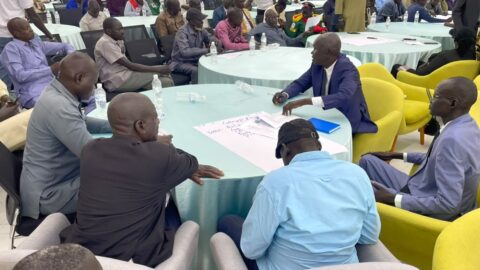
“Business requires a conducive environment, and the primary environment is law. If the country’s laws do not support micro-businesses, citizens will not have the chance to grow economically, and that is precisely what is happening,” Mayar stated on Saturday during entrepreneurship talks at the University of Juba, hosted by the Tonj Youth Union in collaboration with the Greater Gogrial Intellectual Forum.
Mayar lamented the lack of economic sovereignty despite political independence. “We have political sovereignty, but we do not have economic sovereignty. The laws are supposed to provide incentives to South Sudanese citizens; we want an attractive business environment for South Sudanese,” he asserted.
He revealed that both South Sudanese and foreigners pay the same amount for import and export licenses, a practice he described as discouraging for local entrepreneurs.
He further criticized existing legislation, stating, “The law has disappointed South Sudanese. For instance, the Land Act says land belongs to the community, making investing in Juba difficult for outsiders, and even renting may be challenging.”
Emmanuel Monychol Akop, Editor-in-Chief of The Dawn Newspaper, outlined the significant obstacles to business operations in South Sudan, including skyrocketing inflation, limited access to finance and credit, and inadequate infrastructure like roads and electricity.
“For potential entrepreneurs, uncertainty over regulations, taxes, licenses, and administrative requirements can discourage investment before the business has even started operating,” Monychol noted.
He continued, “Every day, we are faced with volatile and aggressive inflation, with the South Sudanese pound losing its value. We are, in many ways, milking a single-source economy, heavily dependent on oil, instead of having a diversified economy.”
Monychol stressed the need to create an environment where South Sudanese entrepreneurs feel confident enough to identify business opportunities, take calculated risks, and transform their ideas into sustainable ventures.
He also called for targeted business skills training to equip young people and potential entrepreneurs with the knowledge required to develop, manage, and sustain businesses.
Makur Abraham Mangar Buong, a South Sudanese entrepreneur and founder of Errandnese Company Limited, emphasized that engaging in business requires courage, self-confidence, and commitment amidst growing challenges.
“Before starting a business, you must identify opportunities. Starting a business also requires an assessment of operational costs to determine profitability. Running a business involves taking risks,” Makur advised.
Abraham Mabior Rioc,a lecturer in the School of Education at the University of Juba, advised aspiring entrepreneurs to avoid exorbitant lifestyles to succeed in small-scale businesses.
Rioc identified several potential business areas, including information and communication technology and graphic design, noting that the private sector employs a larger percentage of the population.
“Start your business with what you have. You can order shoes and clothes, sell them, and make a profit. If you can buy a bale of clothes in Konyokonyo… if you are running a small business, you can eat in a cheap restaurant; eating in a cheaper place is not a social disgrace,” Mabior counseled.
Bush Buse, the Minister of Youth and Sports in Central Equatoria State, highlighted that while the government employs approximately 30 percent of the population, running a business offers significant opportunities for job creation.
“This particular event is a platform to inspire and empower you and make you productive. Young people face contemporary challenges including ignorance, illiteracy, and poverty. We are poor not because of external but internal factors,” Buse stated.
He concluded by encouraging collective action: “If you come together, establish a small business, it can grow into a bigger firm. People do not survive on salary; money is not in government; money is in the private sector, and 70 percent are employed by the private sector.”

Join the conversation
Keep contributions respectful, relevant and suitable for a public newsroom.