
By Simon Deng
In the rural communities of Yei River County, access to small loans is becoming more than just a financial opportunity—it is helping families put food on the table, keep children in school, pay medical bills and build small businesses.
Through microfinance and agricultural support, small-scale farmers, particularly young people, women and other vulnerable rural populations, are finding new ways to generate income and strengthen their livelihoods.
For 31-year-old Johnson Poru Hilary, founder and Chief Executive Officer of Nur Micro-finance Cooperative Society, the idea is simple: when people have access to affordable credit and productive opportunities, they can invest in activities that generate income and help them meet their everyday needs.
“When people become busy, they do things that keeps life moving, people get some money that they are able to meet their daily needs and other essential things for their live, they are able to pay for their medicines, pay school fees for their children and they even to cloth themselves,” Hilary said.
Nur Micro-finance Cooperative Society was established from the need to address the financial challenges faced by young people and women in South Sudan.
“I came up with idea to establish credit facility in 2021, one of the biggest challenge people faces is access to finance to expand business or even start-ups, I am the idea developer but I also share it with like-minded friends,” said Hilary.
Hilary, who holds a diploma in Business Administration from Makerere University in Uganda and is a Certified Public Accountant (CPA) from KASNEB in Kenya, is currently pursuing a bachelor’s degree in Theology from Emmanuel Christian University in Yei town.
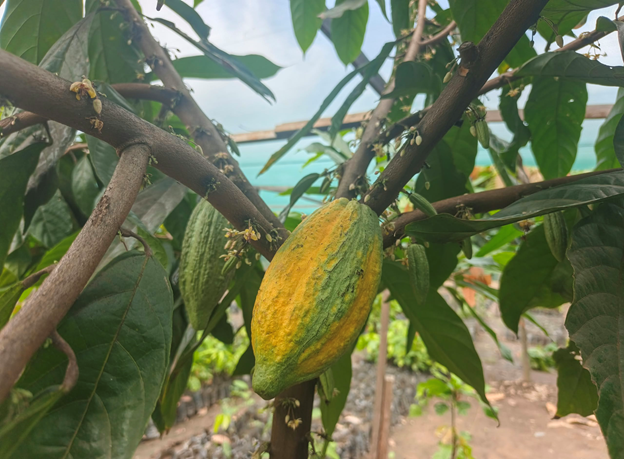
He said the cooperative has expanded its activities beyond microfinance by supporting agricultural production, including cocoa farming, in parts of Central Equatoria State.
“Nur microfinance cooperative, established on the basis of challenges that young people and women continue to face in this country, support women and young people in term of access to credit to boost productions, we introduce cocoa in 2023,” said Hilary in an interview on Friday.
Cocoa and Economic Diversification
South Sudan has huge potential in agriculture, with a five-year master plan expected to boost food production, provide food security with adequate surplus for export, and reverse the country’s dependence on food imports.
Hilary said Nur Micro-finance Cooperative Society has augmented access to finance for small-scale farmers, including farmers involved in cocoa plantations in parts of Central Equatoria State.
He disclosed that the cooperative has so far established a firm network of farmers.
“Currently, we have about 8000 out growers, we have some cocoa farmers in Yei town, in Morobo and Lainya counties,” he said.
According to Hilary, the cooperative introduced cocoa three years ago and has since invested heavily in the production of seedlings and training of farmers.
“We introduce cocoa three years ago and we manage to raise close to 10,000 million seedlings, in the last three years more than four million and less than six millions is left in stock, we support farmers by training.”
Hilary sees cocoa as an opportunity for South Sudan to diversify its economy away from its heavy dependence on oil.
South Sudan has, since independence, hinged on oil production as a major source of revenue. Hilary believes the introduction of cocoa presents an opportunity to diversify the economy and create new sources of income and employment.
“As cooperative, our intention is not to have cocoa farms but to empower people to establish cocoa outgrower schemes, we raise seedlings and we give to outgrowers, each farmer has 5 to 10 feddans of cocoa plantation,” said Hilary.
“We have been entirely depending on oil, but we have to look into diversification of economy that is why we introduce cocoa, we buy cocoa from farmers and then we sell it, we make money through sell of cocoa products,” he said.
Hilary said income levels in the cocoa business are determined by global market rates, while much of the processing of cocoa beans, including products such as chocolate and Vaseline, is currently done in neighbouring countries.
“As cooperative, we are looking at the value chain, cocoa is the green gold, it is expensive, the buyers, sometime buy cheaply and they make more money, they create more jobs, we plan to have mini-factory to process so that we supply finished products.”
He believes establishing local processing facilities could enable South Sudan to benefit more from the cocoa value chain, create jobs and retain more income within the country.

Microfinance and Community Livelihoods
Beyond agriculture and cocoa production, Hilary said the cooperative’s work is also targeting young people, women, returnees and internally displaced persons by giving them access to finance and opportunities to participate in productive activities.
“The Community especially young people, women, returnees, Internally displaced persons, they able to access finance from us and then they become a little busy and there are those that sit in the chain working as logistics officers,” he said.
According to Hilary, access to finance can also have a wider impact on communities by creating productive opportunities and reducing idleness and crime.
“The community has benefited in so many ways, in term of getting into production and that reduces crimes and young people become busier and community makes money when produces are ready.”
Hilary has also undertaken exposure learning, voluntarily helping the African Union on advancing its peace and security agenda, including advocating issues related to overthrow of government over the last two years.
Creating Jobs
Nur Micro-finance has also become an employer in Yei, with plans to expand its workforce as its operations grow.
“We 12 staff and we are looking forward to increase and that is only within microfinance, there agronomist based who are more than 15, we have about 28 staff altogether, there is a plan to extend to other state but we are facing a challenge, we had plan to extend to other part of the country, like Eastern and Western Equatoria and Rumbek.”
With 28 staff members, including microfinance employees and more than 15 agronomists, Nur Micro-finance says it hopes to expand its operations beyond Yei to other parts of South Sudan, including Eastern and Western Equatoria and Rumbek.
However, financial and operational challenges continue to limit the pace of expansion.
How Employees Benefit
The experience of Nur Micro-finance employees themselves illustrates the wider impact of employment and access to income.
Bida Peter Thomas, the organisation’s Operations and Partnership Manager, said his income has enabled him to pay his children’s school fees, meet medical expenses and provide food for his family despite the country’s difficult economic conditions.
“As an employee of Nur Microfinance, I am able to pay my children school fees and also under currently economic situation, my family eats twice in a day, pay medical bill and many other things,” said Thomas.
Thomas, a father of five whose left leg was amputated following a terrible night attack in 2017, said his first-born child is now enrolled in Primary Eight at a private school in Yei town.
His experience reflects how employment and income can directly affect the wellbeing of families, particularly at a time when many households are struggling with rising economic pressures.
Thomas said the improving security situation has also created opportunities for farmers to expand their agricultural activities.
“The security situation has seen improvement, we have farmers staying 30 miles away from Yei town, currently, I have a feddan of cocoa, the harvest will be expected next year, we encourage farmers to engage in food production,” he said.
Agriculture as a Path Out of Poverty
Thomas believes agriculture remains one of the strongest opportunities for South Sudan to reduce poverty and improve food production.
“We can do best in term of agriculture, let us focus on agriculture, which is the only way to reduce poverty, we have to use tractors, subsistence farming is for home consumption, for us to export, we mechanized to export to outside countries,” he said.
He also called for increased investment in microfinance and agricultural production, arguing that government support could help expand access to finance.
“I think with microfinance, families and government to access loan but current situation, government can inject some cash to boost finance, to move forward is through agriculture and microfinance institutions.”
Empowering Women
For women farmers, access to credit is providing another route to income generation and economic independence.
Viola Nyoka, chairperson of Comore Women Farmers’ Cooperative, said the credit facility has, since 2023, created a programme dubbed “Empower Her” specifically to support women in several parts of the country.
“The microfinance is actually helping us to access loan, we access loan as group but also as individual, we do get loan and they also give services of cocoa plantation, we picked loan and farm crops like maize and groundnut,” said Nyoka.
She said the loans have helped women purchase seeds, pay for labour and generate income from agricultural production.
“Personally, produces are finally sold, that generate income to support livelihoods, we have benefited from loan and also village saving loan association (VSLA) program, we buy seeds and we use to pay for labor, we are looking forward to establish cocoa plantation, cocoa is a long term project,” Nyoka said.
As South Sudan faces economic pressures and limited employment opportunities, microfinance and agriculture are increasingly being viewed as potential engines for household income, local enterprise and rural economic growth.
For farmers, women and young people in Yei River County, the combination of access to credit, agricultural training and markets could mean more than simply earning an income. It could provide a foundation for stronger families, more productive communities and a more diversified South Sudanese economy.

Join the conversation
Keep contributions respectful, relevant and suitable for a public newsroom.