
By Waure Eddy
In the midst of South Sudan’s worsening economic hardship and rising unemployment, Faith Work’s Company Limited is emerging as a beacon of hope for young people and women seeking a better future in Western Equatoria State.
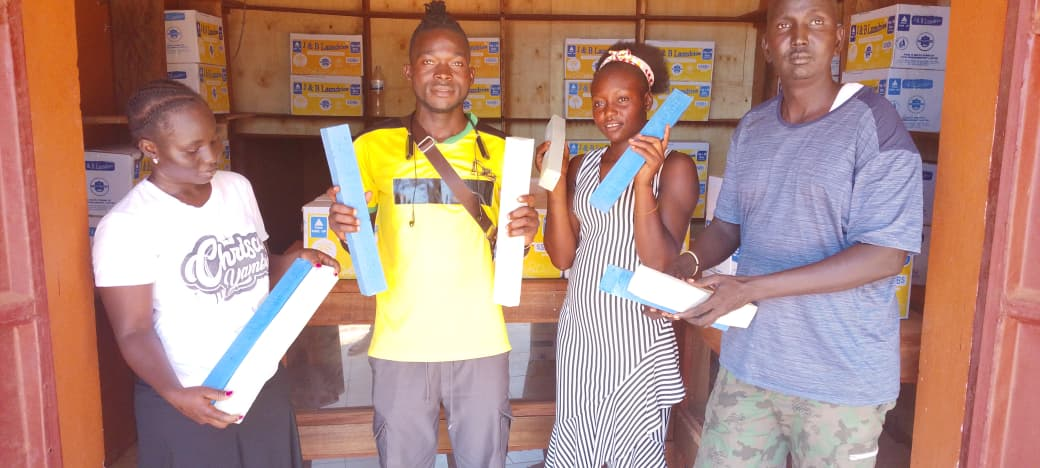
This locally owned company, which specializes in soap production, is not only creating jobs but also transforming lives by equipping youth with practical skills, financial independence, and dignity. With seven employees — four men and three women — directly benefiting from the enterprise, the company is helping families survive during difficult economic times while inspiring young people to embrace self-reliance and entrepreneurship.
For workers like Lucy Maku Wilson and Jovana Roller, employment at the factory has become more than just a source of income; it is a pathway to stability and a better future.
Lucy Maku Wilson, a soap controller at the company, said the opportunity rescued her from severe financial struggles and enabled her to support her family.
“After completing Senior Four in 2025, I joined the company as a single mother. This job provides food for my family,” she told The Dawn. “I believe that in the coming years, this company will grow into something bigger because the founder is working hard to make things succeed.”
Wilson added that the company is not only helping her financially but is also building her skills and confidence.
Jovana Roller, a marketer at the factory, shared a similar experience. After completing computer training at Yambio Vocational Training Centre, she secured employment with the company and stated that the job has given her independence during the ongoing economic crisis.
“This work is helping me a lot during the economic crisis,” Roller said. “Customers come at any time to buy soap, and it has no side effects. I am no longer depending on men’s support, which is unreliable. This job gives me independence.”
The company’s mission extends beyond employment. According to Matuol Manyok, a consultant and soap manufacturing professional working with the enterprise, the initiative aims to reduce dependency on imported soap while creating sustainable livelihoods for local communities.
Manyok, who also serves as production manager for Bidi Soap Factory in Uganda’s Bidibidi refugee settlement, has spent the past four months in Western Equatoria helping finalise the setup of the Joint and Business Enterprises Soap factory.
“Our mission is to eliminate soap imports into Western Equatoria State,” Manyok explained. “People in Western Equatoria spend more than 9 million US dollars annually importing soap from Uganda and Kenya. Yet this state has abundant palm oil, a resource that can solve the soap import problem not only for Western Equatoria but for South Sudan as a whole.”
He emphasized that the company is committed to empowering young people and women by utilising locally available resources to create employment opportunities.
“We need our communities to benefit from this product because we have a lot of palm oil in our country that is being wasted,” he said. “This enterprise is about turning that opportunity into sustainable livelihoods.”
The factory’s installed machines can produce up to 13 bars of soap per minute, translating to 780 bars per hour and approximately 6,240 bars daily during an eight-hour shift. However, production remains below capacity because much of the process is still manual.
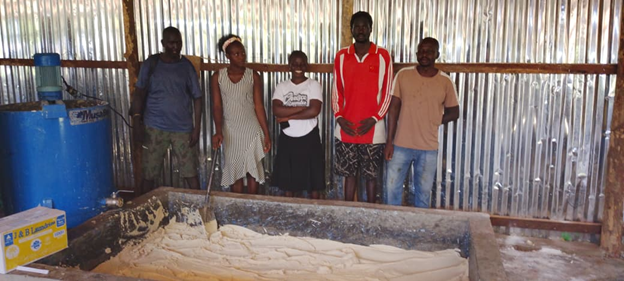
“The machine is working at 50 percent capacity, but we are only utilizing about 20 percent because we are manually handling the soap,” Manyok noted. “We need to acquire a roller machine to improve the texture and increase output.”
Despite these challenges, the enterprise continues to grow steadily. Each bar of soap is sold for 10,000 South Sudanese Pounds, while a full box contains 20 pieces, making the product accessible to households and small businesses.
The company’s impact is already evident in the lives of its workers. George Friday, the operations manager, said joining the factory completely changed his life.
“Before joining, I was a farmer. After one month of training, I learned how to make soap,” Friday said. “Now I can support my family, pay school fees for my children, and even pay workers on my farm. I encourage my colleagues to join any kind of work that generates income instead of sitting idle.”
Faith Work’s Company Limited, founded on February 20, 2026, has made significant progress in agro-processing and community-based business within just three months of operation.
The company has already opened branches in Nzara, Makpandu, and Nabiapai, extending its services to border communities between South Sudan and the Democratic Republic of Congo. It also has ambitions to expand into neighbouring countries once stability improves.
Operating under its flagship initiative, Joint and Business Enterprises Soap, the company uses locally sourced palm seeds and palm oil to produce affordable soap for local communities.
The enterprise purchased its machinery from Musabel, a Ugandan manufacturer, in 2021. The equipment includes a boiler machine valued at 1,500 US dollars, a polder machine costing 2,500 US dollars, and a control machine worth 1,000 US dollars, bringing the total investment to 5,000 US dollars.
These machines form the backbone of the soap production process, which currently consumes 50 jiarakan of palm oil per production cycle.
Beyond providing employment, Faith Work’s Company Limited is nurturing skills among youth and women, empowering them to support their families and rebuild hope amid South Sudan’s ongoing economic crisis.
As unemployment continues to affect thousands of young people across the country, the company stands as an example of how local businesses can create opportunities, strengthen communities, and restore dignity through meaningful work.
Join the conversation
Keep contributions respectful, relevant and suitable for a public newsroom.