
By Jenifer James
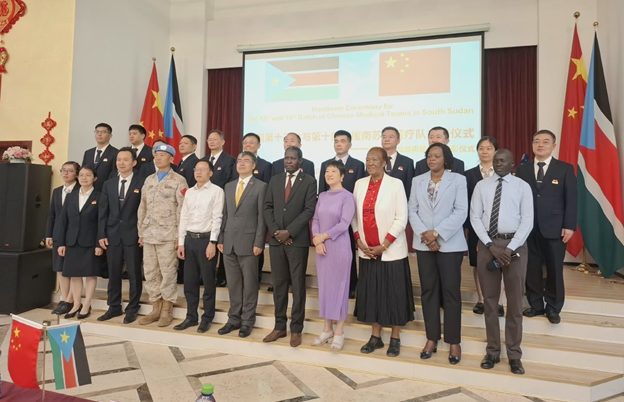
The National Minister of Health Luke Thompson has called for an increase in the number of Chinese doctors serving in South Sudan to about 32 in the coming years, as the government seeks to expand Chinese-supported healthcare services beyond the capital, Juba. His call comes as the 14th Chinese medical team begins its mission in the country.
Speaking at a handover ceremony on Wednesday, Thompson emphasized that these additional doctors would facilitate the extension of medical cooperation beyond Juba Teaching Hospital to underserved regions, particularly Malakal in Upper Nile State and Western Bahr el Ghazal State, where healthcare needs are pressing.
The Chinese Embassy commended the outgoing 13th medical team for treating thousands of patients and significantly enhancing South Sudan’s healthcare capacity.
Thompson specifically urged the expansion of Chinese-supported medical services to Malakal, Upper Nile State, and Western Bahr el Ghazal State, highlighting the urgent demand for additional healthcare support in these areas.
“We commend the support we have been doing in collaboration with Juba Teaching Hospital, but call upon your gracious commitment in helping South Sudan to expand the services to the states, particularly in Upper Nile State and Western Bahr el Ghazal State,” Thompson stated.
Dr. Jackline Albino, Deputy Director General of Juba Teaching Hospital, expressed gratitude to the Government of China for its consistent support to the hospital since 2012.
“For the last 13 years, the Chinese medical team has been consistently there at Juba Teaching Hospital, from 2012 up to date, and they have been doing a great job,” Albino remarked.
She noted that the medical teams’ contributions extended beyond patient treatment, encompassing the sharing of knowledge, skills, and experience with South Sudanese healthcare professionals.
“You have not only provided medical services, but you have also shared your skills, your experience, your knowledge, and commitment with our local medical team,” she added.
Albino also thanked the departing medical team, specifically Batch 13, for their contributions to Juba Teaching Hospital and South Sudan’s health sector.
Meanwhile, Charge d’Affaires ad interim Huo Ying conveyed appreciation to the Ministry of Health and other partners for their support in fostering China-South Sudan health cooperation.
Huo praised the outgoing medical team for its year of service, highlighting their dedication to patients and commitment to improving healthcare in South Sudan.
“With your superb medical skills, you treated tens of thousands of patients and actively launched projects on cervical cancer screening and laparoscopic technique training,” Huo stated.
She noted the team’s initiative in developing a “never-leaving medical team” approach, designed to strengthen South Sudan’s medical service capacity and technical expertise beyond the physical presence of Chinese doctors.
Huo urged the incoming 14th medical team to build on these achievements by quickly adapting to the local environment, integrating into the community, and maintaining a strong sense of responsibility.
Meanwhile, Dr. Janet Michael, Director General of the Ministry of Health, commended the outgoing team’s significant contributions to the country’s healthcare sector.
Dr. Janet emphasized that the Chinese medical team’s work extended beyond clinical services to include medical knowledge-sharing and cultural exchange, positively impacting many South
Sudanese lives. “There is a lot of work that has been done—clinical, medical, cultural—and this has touched many lives. Our people also appreciate your contribution,” she said.
Dr. Janet also observed that traditional medicine remains deeply rooted in South Sudanese communities, particularly among those living far from health facilities.
“Our people in South Sudan are also embedded in their traditional medicine. While we have not yet expanded our traditional medicine, it needs more research,” she explained.
She proposed collaboration with Chinese medical experts to research medicinal herbs used by communities across the country.
“Maybe collaborating, we can work on research to find these known herbs that we have in South Sudan. Actually, a lot,” she suggested.
Zhang Erqing, leader of the outgoing 13th Chinese Medical Team, reported that during their one-year deployment at Juba Teaching Hospital, the team provided over 13,500 outpatient consultations, treated 1,700 inpatients, and conducted more than 200
surgeries. The team also successfully rescued over 50 critically ill patients and introduced new medical services, including South Sudan’s first digital PACS imaging system, the first ultrasound-guided breast biopsy, laparoscopic minimally invasive surgeries, standardized fetal monitoring, and expanded cervical cancer screening. “Over the past year, we have focused on clinical treatment and broken multiple local medical bottlenecks,” Zhang stated.
Zhang added that the team prioritized training local health workers through lectures, bedside tutoring, and live surgical demonstrations covering emergency rescue, trauma management, aseptic operations, and epidemic prevention. He highlighted the establishment of the Laparoscopic Minimally Invasive Surgery Center at Juba Teaching Hospital in July 2026 as a major milestone.
Join the conversation
Keep contributions respectful, relevant and suitable for a public newsroom.