
By Jenifer James
The United Nations Commission on Human Rights in South Sudan has issued a stark warning: renewed violence, escalating political tensions, shrinking civic space, rampant corruption, and persistent impunity are jeopardizing the country’s fragile political transition, threatening civilians ahead of the planned December elections.
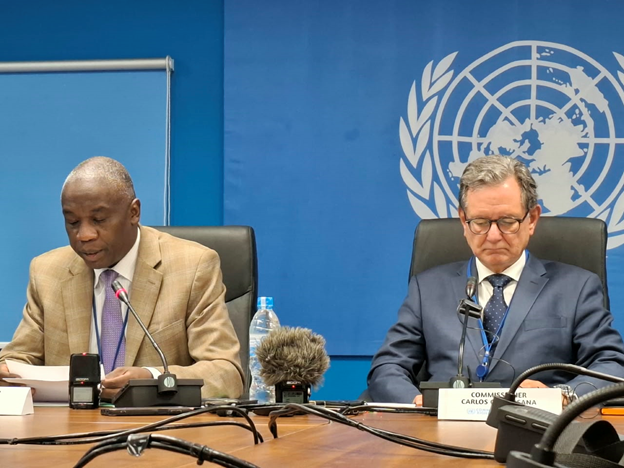
This warning follows the Commission’s 14th visit to South Sudan, a four-day engagement with government officials, political and security actors, civil society representatives, victims and survivors, humanitarian partners, and members of the legal community.
During a visit to Bor, Commission Chairperson Yasmin Sooka reported that survivors of recent fighting in northern Jonglei State described severe human rights violations, including sexual violence against women and girls, killings, displacement, and family separation.
She highlighted the ongoing struggle for some survivors to access essential medical and psychosocial support, underscoring what the Commission termed “continuing failures to adequately protect civilians and respond to abuses.”
Sooka emphasized this point, stating, “Visit after visit, we continue to hear from people who bear the consequences of violence, displacement, insecurity, and the failures of those with political and security responsibilities to prevent and address those harms.”
The Commission identified killings, displacement, attacks on civilians and civilian infrastructure, disruption of humanitarian operations, and insecurity among aid workers as major ongoing concerns. It urged all parties to adhere to international human rights and humanitarian law and to implement concrete measures for civilian protection.
The Commission also called for an independent investigation into an attack on a UNMISS patrol in Jonglei State that resulted in the deaths of two peacekeepers and injuries to others.
Sooka maintained that South Sudan still has an opportunity to prevent further deterioration through genuine political dialogue, civilian protection, and safeguards for a peaceful and credible transition.
Meanwhile, Commissioner Barney Afako noted that the implementation of the Revitalized Agreement on the Resolution of the Conflict in South Sudan has stalled due to a narrowing of political and civic space.
“Even as the country heads for elections, political and civic space has narrowed, while many of the safeguards and conditions for peaceful and credible polls are still missing,” Afako stated.
He advocated for inclusive political dialogue involving all political actors, including the SPLM-IO, holdout groups, civil society, women, and youth.
Afako also urged the release of detained political opponents unless they are promptly brought before independent and impartial courts.
However, Commissioner Carlos Castresana Fernández highlighted impunity as a significant barrier to ending violence.
“All these years, the Commission has documented serious violations and identified the same underlying problem: impunity,” he asserted.
He pressed the government and the African Union to accelerate the establishment of the Hybrid Court for South Sudan and to operationalize transitional justice mechanisms, including the Commission for Truth, Reconciliation and Healing.
Fernández also expressed concern over the limited implementation of recommendations on corruption, warning that the diversion and misallocation of public resources undermine citizens’ rights, especially as humanitarian needs escalate.
Join the conversation
Keep contributions respectful, relevant and suitable for a public newsroom.