
By Simon Deng
Juba National Prison is currently holding 3,270 inmates, including 342 juveniles and 99 women. The facility’s director has appealed for continued support for vulnerable prisoners.
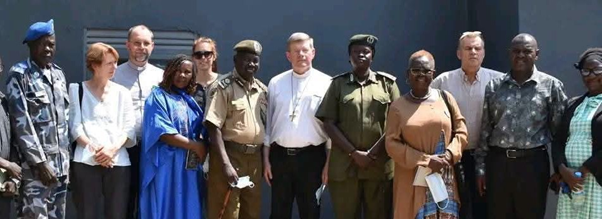
On Friday, Maj.Gen. Antony Oliver Legge, Director of Juba National Prison, welcomed a delegation from Misereor, the German Catholic Church’s Development Cooperation Organization. Misereor, through its partnership with Women Equity, supports various programs at the prison, including legal assistance, counseling, and awareness activities for families of juvenile inmates.
Director Legge expressed his gratitude to the Misereor delegation for visiting the crowded facility.
“We are happy to receive the Misereor delegation, our funders from Germany, who consistently collaborate with Women Equity to support Juba National Prison, particularly the female wing and the juvenile reformatory school,” Legge stated during the visit.
He further elaborated on the work being done: “Women Equity has conducted legal work, counseling, and awareness creation for families of juveniles. Currently, we have 3,270 inmates, with 342 in the juvenile section and 99 in the female wing; the remaining are male inmates.”
Legge noted that the overcrowding at Juba National Prison reflects a rise in community crime. He highlighted ongoing economic reforms within the prison, including vocational training offering 12 different trades.
“We have vocational training with 12 trades.There is also ongoing improvement in accommodation, with renovations being undertaken by the government and other businesses, and our situation is improving,” he explained.
“We have added some dormitories. Electricity and water remain challenges, but we are looking forward to installing a solar system. We also need to work with the judiciary to expedite trials to reduce the number of inmates in remand.”
Archbishop Stefan Burger, of the Diocese of Freiburg in Germany, stated that the Misereor delegation visited Juba National Prison to observe the living conditions of inmates, including juveniles.
“As the church, we wanted to learn about South Sudan. We aim to strengthen communities affected by conflict, poverty, and even imprisonment. We must deepen the bond of solidarity between people across the globe,” said Burger.
“Jesus Christ united people through love. We encourage people and are trying to build their future. We are here from Misereor to provide support to the prison, and we also support other projects including education and health.”
The Misereor delegation, led by Archbishop Burger, concluded an eight-day visit that included Rumbek in Lakes State, Malakal in Upper Nile, and Juba in Central Equatoria State.
Misereor collaborates with the Sudan and South Sudan Catholic Bishops’ Conference to support peace-building initiatives, education, trauma healing, and humanitarian relief for displaced communities across the country.
Esther, a female inmate in Juba National Prison, appealed for improved health services for those in custody.
“We lack medical facilities. Each time you become sick, it is not easy to get treatment. Most of us do not have visitors; others are thrown here and forgotten. We need medical facilities for our emergency cases,” she said.
She also emphasized the need for vocational training. “When you come in as a prisoner, you lose your source of livelihood, and when you are released, you have to start a new life, which is very difficult. Livelihood skills should be given to us willingly, not forced.”
Natalina Andrea, Director of Women Equity, confirmed that Misereor has actively funded projects in Juba and across South Sudan.
“As Women Equity, we have received tailored support from Misereor and have managed to achieve positive outcomes. Misereor funding has increased efforts to promote gender equity, legal rights, and the rehabilitation of women,” Andrea stated.
She also highlighted ongoing challenges: “We still have our challenges. Children and underage girls should not be kept with adult women; there is a need for a reformatory school. Some women with children are sleeping inside, and it is not healthy for the children.”
Join the conversation
Keep contributions respectful, relevant and suitable for a public newsroom.