
By Jenifer James
South Sudan has activated a high-level, multi-agency task force to prepare for a possible Ebola outbreak following reported cases in neighbouring Democratic Republic of Congo (DRC) and Uganda, elevating the country’s national response mechanism to a heightened level of alert.
Established by President Salva Kiir Mayardit on September 7, the task force will coordinate surveillance, prevention and rapid response efforts across government institutions should an Ebola case be detected in South Sudan.
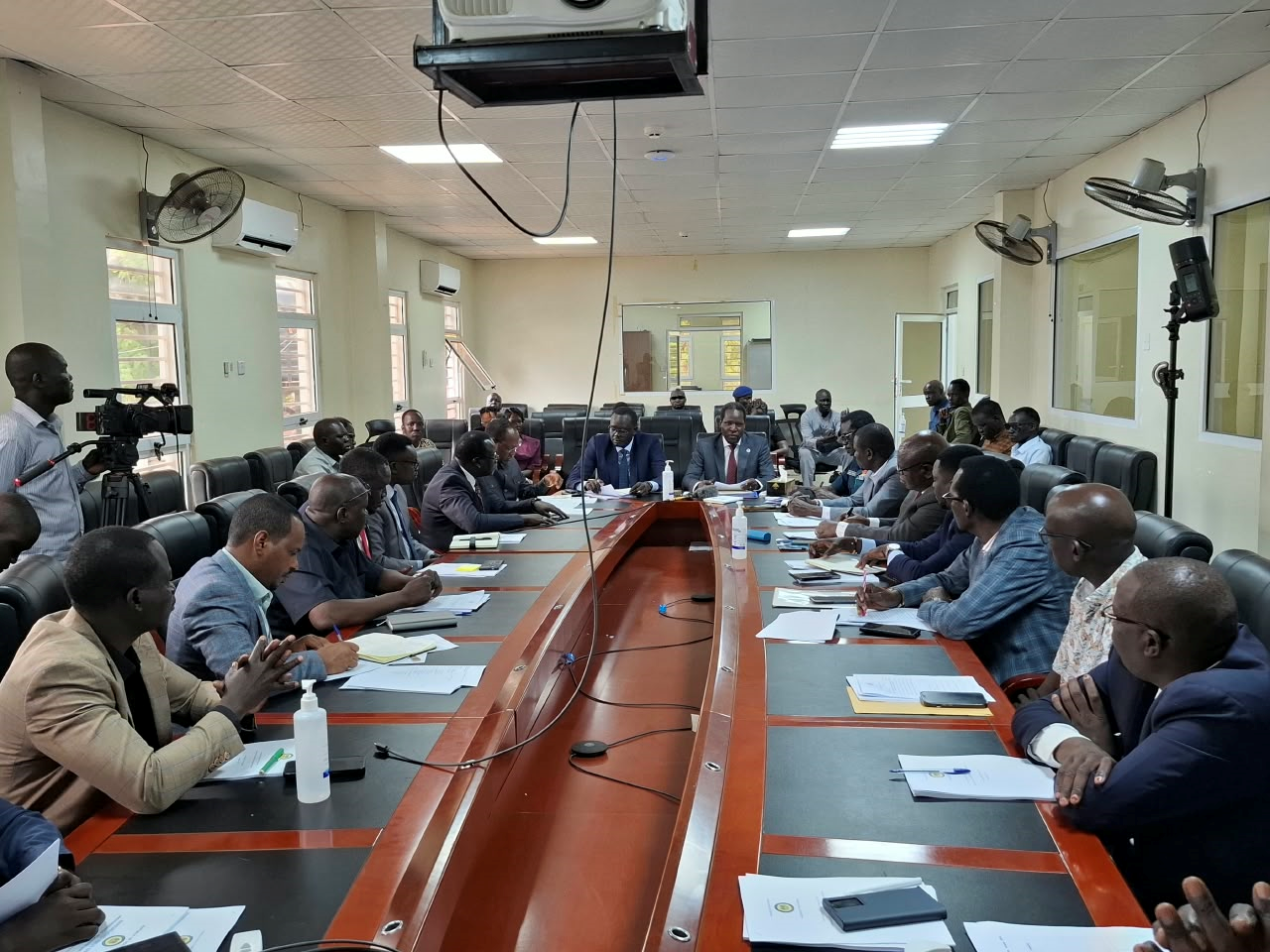
The committee brings together health authorities, security agencies and other government institutions to strengthen the country’s preparedness and response to any suspected Ebola case.
During the task force’s inaugural meeting on Tuesday, Health Minister Luke Thompson said the response mechanism had been expanded to include institutions beyond the health sector.
“Since continental and international health agencies have categorized countries bordering DRC as areas susceptible to Ebola importation, we decided to elevate the status of our response mechanism,” Thompson stated.
“Instead of it being solely under the Ministry and the National Public Health Institute, there is a necessity and urgency for other institutions to be included.”
Thompson explained that the Ministry of Health and the National Public Health Institute (NPHI) submitted their request on August 21, 2026, following reports of Ebola outbreaks in neighbouring countries.
“Our request as the National Ministry of Health and National Public Health Institute was informed by the outbreak of Ebola in our neighboring countries, particularly in DRC and the Republic of Uganda,” he said.
The minister emphasized that South Sudan’s proximity to affected countries and its porous borders increase the risk of disease importation, making cross-government coordination critical.
He said the task force would provide a broader platform for government agencies and partners to collaborate on detecting, preventing and responding to any potential Ebola threat.
Thompson also cited public health emergency declarations by the Africa Centres for Disease Control and Prevention (Africa CDC) and the World Health Organization (WHO) as factors increasing the urgency for South Sudan to strengthen its preparedness.
“These two declarations categorize South Sudan, Congo-Brazzaville, Angola, Burundi, Rwanda, and Central African Republic as high-risk countries for importation due to their seamless borders with the epicenter of the Ebola outbreak, which is DRC and Uganda,” he explained.
Meanwhile, Africa CDC Chairperson Zerihun Kassa underscored the importance of strong coordination among governments, health authorities and partners in mounting a continental response.
“I would like to bring you today, on behalf of the government, the response to this important public health emergency,” Kassa said.
He commended South Sudan’s health experts and government institutions for their role in the response, affirming Africa CDC’s leadership in continental efforts.
“The Africa Centres for Disease Control and Prevention (Africa CDC) is currently leading this response at the continental level.”
Kassa reported that the latest formal assessment indicated that the public health situation remains challenging due to difficulties in containing the outbreak.
“We have determined the level of readiness for the response, and we remain committed to continuing our efforts,” he stated.
He also called for continued support from development and health partners to ensure that preparedness activities are coordinated and aligned.
“We also appreciate the support of our partners because we have to ensure that our efforts are coordinated and aligned with our partners’ programs and sectors.”
For his part, WHO Emergency Lead Aggrey Bategereza stressed that the task force must translate preparedness plans into practical action before any Ebola case reaches South Sudan.
“An outbreak does not test the quality of our plans. It tests whether our systems work when the first alert comes to South Sudan,” Bategereza warned.
He explained that preparedness depends on the ability of health workers and communities to identify suspected cases, report alerts quickly, safely isolate patients, transport samples to laboratories and trace contacts.
“When that first alert is received, whether it is received in Yambio, Yei, Maridi, Kajo-Keji, Magwi, Juba, or anywhere else, the real questions will be very practical: Can health workers and communities recognize that first case? Can the alert be reported immediately? Can the patient be safely isolated?” he asked.
Bategereza emphasized that communities must also receive timely information without creating unnecessary fear.
“Can contacts be identified and followed? Can communities be informed without creating fear? And can all of us work together as one team?” he questioned, noting that these measures collectively define national readiness.
“Ebola virus disease requires us to act before the first case arrives in South Sudan, not after it has arrived.”
The WHO official also cautioned that preparedness must account for cross-border movement through roads, markets, health facilities and informal crossings.
“We must also remember that the border is not simply a line on a map. People move through roads, markets, families, health facilities, and informal crossings,” he said.
“Our preparedness must therefore follow the way people actually live and move.”
Bategereza concluded that the first meeting of the high-level task force presented a crucial opportunity to move beyond theoretical preparedness plans and ensure that systems are tested and operational at all levels.
“This High-Level Task Force meeting is an important opportunity to move from preparedness on paper to preparedness that is tested, verified, and operational at all levels,” he affirmed.
The task force is expected to serve as the central coordination mechanism for South Sudan’s Ebola preparedness, bringing together health, security and other government sectors to ensure rapid detection, coordinated action and an effective national response to any potential outbreak.
Join the conversation
Keep contributions respectful, relevant and suitable for a public newsroom.