
By Jenifer James
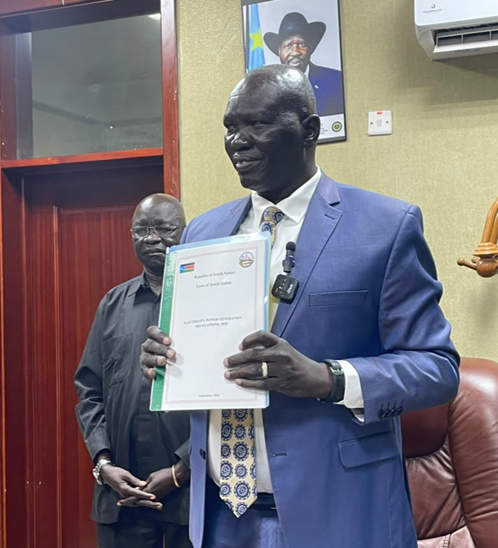
The Ministry of Energy and Dams has officially signed a new regulation to govern electricity generation, establishing a crucial legal framework designed to attract investment, dismantle existing barriers, and provide a clear roadmap for the sector’s development.
National Minister of Energy and Dams, Agok Makur Kur, stated that this regulation is a cornerstone of the ministry’s short- and long-term strategies to overcome challenges in the energy sector and guide its future growth.
During the signing ceremony at the Ministry of Energy and Dams on Thursday, Minister Kur emphasized the regulation’s specific focus on electricity generation.
“Today, the important regulation we need to sign concerns electricity generation in South Sudan,” he declared.
The minister clarified that this electricity generation regulation is one of three vital regulatory documents currently being developed for the energy sector.
Regulations addressing electricity transmission and distribution are still undergoing review by the Ministry of Justice.
“These are still with the Ministry of Justice,” Kur confirmed, referring to the outstanding regulations.
Kur explained that these regulations aim to bolster confidence among investors and development partners by providing clear operational guidelines for the energy sector.
“Through this regulation, our investors and partners can be confident that the Ministry of Energy has a regulation to organize the work of the energy sector in South Sudan,” he noted.
He also acknowledged the dedicated work of the committee responsible for drafting the electricity generation regulation, including the ministry’s Undersecretary, Legal Director Simon Wright, and other contributing members.
The minister assured that the regulation had undergone thorough review and debate through all relevant legal processes prior to its signing.
Kur further stated that the regulation will be made accessible through the ministry and published in the official gazette, ensuring all stakeholders can access its provisions.
The Ministry of Energy and Dams views this new regulation as a significant stride towards establishing a structured framework for electricity generation, crucial for the government’s efforts to attract investment and expand energy access across South Sudan.
The minister underscored the profound importance of electricity to the nation, asserting, “Without energy, there is no life.”
Meanwhile, Macham Macham Angui, Undersecretary at the Ministry of Energy and Dams, attributed recent electricity interruptions to routine maintenance at power facilities.
Angui explained that these maintenance activities are essential because the power generation system, particularly when using heavy fuel oil, requires regular cleaning.
He noted that maintenance is typically conducted from 6 a.m. to 6 p.m. and can occur in various areas based on operational needs.
“They have to do the maintenance, and that one is at six in the morning up to six in the evening,” Angui stated.
The Undersecretary emphasized the critical nature of the cleaning process, as heavy fuel oil can leave deposits that must be removed from the system to ensure efficient operation.
Join the conversation
Keep contributions respectful, relevant and suitable for a public newsroom.