
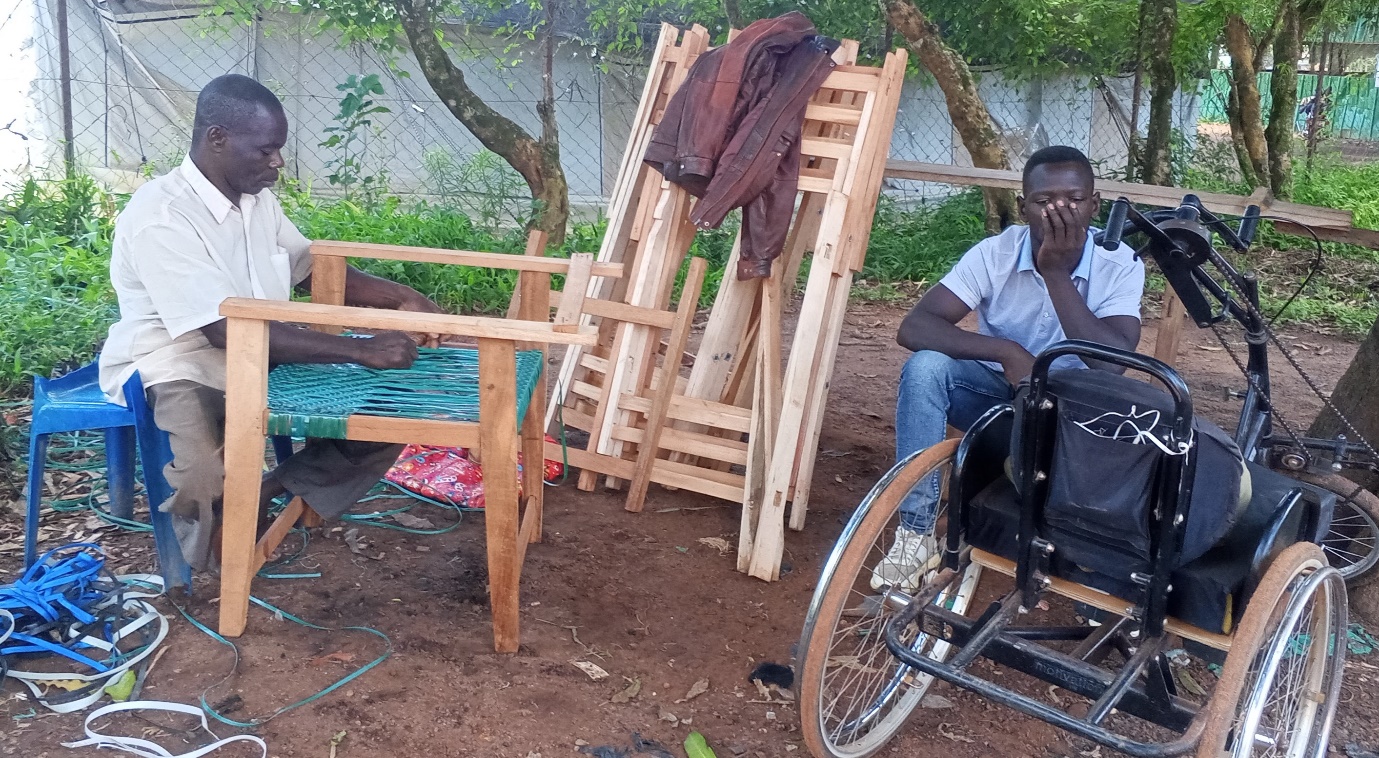
Darugu Stephen, at his work place near palace in Napere
By Waure Eddy
On the busy roadside of Yambio, a sharp, rhythmic tapping of a hammer cuts through the daily traffic and noise of the street. Beneath the shade of a wide Mongo tree, 42-year-old artisan Dorugu Stephen Wangate sits in his wheelchair. He is a man of quiet focus, turning raw timber into strong, locally crafted chairs. For him, each piece of furniture is more than an object; it is a symbol of survival. With every chair sold, Wangate pays his children’s school fees, puts food on the table, and sustains his family. His small roadside workshop has become a symbol of enduring spirit, demonstrating to all who pass by that physical disability does not equal inability, and that determination can carve out dignity and a future.
Wangate was not born with a disability. “My father told me I was fine after birth. But when I was just a few days old, I contracted malaria and polio. That illness changed everything,” he affirms. The illnesses shaped his path, confining him to a wheelchair.
He was born in South Sudan and raised in the Democratic Republic of Congo. He began repairing phones, radios, and televisions at the age of 10. “For 20 years, that work helped me survive. It paid for food, medication, and even school fees,” he said.
When he returned to South Sudan in 2020, he found a new challenge: his former trade was no longer practical. “I couldn’t continue repairing electronics anymore It was hard to move around, and the tools I needed were not easy to access,” he recalls.
Rather than surrendering to these new circumstances, Wangate found a different direction. He began to learn woodworking, crafting beautiful and sturdy furniture from locally sourced timber. His business model is simple yet effective. He makes five chairs a week, focusing on quality above all. “I make big chairs for 250,000 SSP, medium ones for 200,000 SSP, and smaller ones for 150,000 SSP. They’re finished within three days because I focus on quality,” he says proudly. “My customers love my work.” His chairs have now found homes not only in Western Equatoria but also in Juba, Uganda, and even as far away as the United States. “In 2024, an American man bought one of my chairs and took it to his country,” Wangate beams. “That gave me hope. I’m doubling my efforts now because people are encouraging me to continue.”
Wangate is a father of six and the sole provider for his children after he separated from their mother. “I stopped school in Primary Eight because of fees,” he shares. “But I’m working hard so my children don’t have to stop. They must succeed in their education.” His determination is a wellspring of strength. “Sometimes I feel tired,” he admits. “But when I see my children going to school, I gain strength. This job is helping me and my family survive.”
His business is a lifeline. He divides his earnings into three parts: one for medication, one for food, and one for school fees. “So far, I’ve saved over 3 million SSP,” he explains. “I use that to buy timber and other materials I need for my work.” He has also become a local icon of innovation. “Many people come to see how I work. They ask questions and take pictures. I tell them, ‘Disability is not inability.'”
Though his workshop is humble, Wangate dreams big. “I want to train young people,” he says. “If I get a budget, I’ll start teaching them how to make chairs. This work can help others, just as it helped me. I believe in sharing skills.” His vision is rooted in community empowerment, seeing his personal craft as a means to a collective future. “If I can help others become self-reliant, we will all grow together.”
Wangate’s story challenges stereotypes and redefines what it means to be self-reliant. “I don’t want pity. I want people to see my work and respect it,” he says. “I’m not just surviving—I’m building something.” Every nail he hammers is a step toward a better future, a testament to the quiet strength of a father determined to uplift his family and community. “I want to be remembered not for my wheelchair, but for my work. For the chairs I built and the lives I touched.”
His story is a powerful reminder of the potential that lies within every individual. “I’m not done yet,” he says with a smile. “There’s still more to build.”
Join the conversation
Keep contributions respectful, relevant and suitable for a public newsroom.