
By Jenifer James
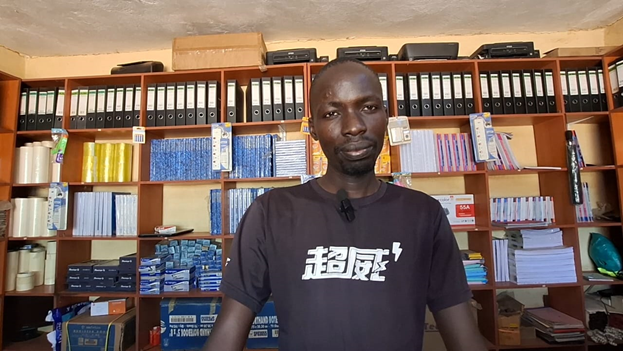
In a society where many young people grapple with unemployment, peer pressure, and limited opportunities, two determined 25-year-olds are demonstrating that change begins with a single courageous decision. In 2021, Faliriano Otuba launched his “Sun Down Bookshop” printing business with only 100,000 South Sudanese Pounds and a laptop he already owned. With minimal capital but unwavering resolve, he purchased a printer and basic supplies, laying the groundwork for his entrepreneurial journey.
Meanwhile, Alfonse Kelam faced a different struggle. Surrounded by idle peers and gang influence, he chose to leave the streets and step into a small unisex salon. What started as a simple job became a pivotal moment—transforming his life from dependence and uncertainty to responsibility and self-reliance.
Their stories convey a powerful message: youth transformation is achievable when courage meets opportunity.
“I started this business with only 100,000 SSP, which I used to buy a printer and basic supplies. I already had a laptop, so that helped me begin,” Faliriano shared in an exclusive interview with the Dawn Newspaper in Torit, where his bookshop operates.
Initially, his main customers were students. He typed assignments, formatted research papers, and printed academic materials. As word spread across schools and colleges in Torit, his client base grew.
“At first, I was only helping students print and prepare their research papers. But as more customers came, I realized there was a bigger opportunity.”
Rather than spending his early earnings, Faliriano reinvested in the business. He expanded his inventory to include exercise books, envelopes, textbooks, and printing paper. Over time, his small printing desk transformed into a fully operational stationery and printing center. Later, he added laptop and printer repair services, further strengthening his enterprise.
Today, the business generates between 2 to 3 million SSP per month, especially when he secures contracts with organizations.
“Currently, the business can generate around 2 to 3 million SSP per month, particularly during school registration periods when parents and students need supplies,” he explained.
This income has brought stability to his household. Rent is paid on time, school fees for his children are covered, and food and medical expenses are managed. He continues to set aside part of the earnings for maintenance and expansion.
“The income helps me pay rent, school fees for my children, food, and medical expenses,” he says. “I also save part of the money to expand the business and maintain equipment.”
His enterprise has also created jobs for several staff members. Although their salaries are modest, Faliriano notes that they significantly support their families.
A major turning point came when he formalized the business. After obtaining the necessary government licenses and registering with the Chamber of Commerce, he gained access to institutional clients.
“Getting the legal documents was not easy, but it allowed me to approach organizations and apply for pre-qualification, That is when the business started to become more stable.”
Despite challenges like delayed payments and high taxes, Faliriano remains committed to operating legally.
“Even if business is slow, we still pay taxes. It protects the business and builds trust.”
Looking ahead, he plans to expand into skills development by opening a training center focused on computer literacy and printer and laptop maintenance.
“Many young people need these skills to create their own opportunities,” he says.
For aspiring entrepreneurs, his message is clear: “Start small with what you have. Focus on gaining skills and reinvest your profits. With patience and discipline, your business will grow.”
In a country where formal employment opportunities are limited, entrepreneurship is becoming both an economic solution and a catalyst for social change.
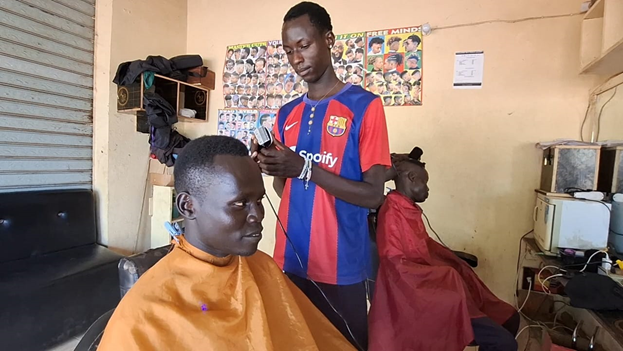
Alfonse Kelam, another young entrepreneur, made his own life-changing decision in 2023 by choosing hustle over gangs in Torit.
At 25, Alfonse left behind idle peers to join a small unisex salon. His choice was not just about earning money but about reclaiming his future.
Dressed in a Barcelona jersey and black trousers during the interview, Alfonse welcomed the reporter as he busily styled a customer’s hair.
He shared how he left gang life for a business that now helps pay for his education and other basic needs.
“At first, I was with groups who did nothing and didn’t help at all; I depended on my parents for everything,” Alfonse admitted.
Like many young people, he faced pressure from unproductive friends and gang culture. Over time, he began to question where that path might lead.
“I realized that if I continued like that, I would not achieve anything. Some youths end up in prison because of bad groups.”
Joining a colleague in the salon marked a shift in his mindset. Slowly, the business began to grow. Today, Alfonse earns at least 100,000 SSP, allowing him to buy his own clothes, pay his school fees, and support his mother with food expenses.
“Now I make my own money. I can pay my school fees and help my mother with feeding. That feels very good,” he says with pride and laughter.
For Alfonse, entrepreneurship represents dignity, responsibility, and independence. He now encourages other young people in Torit to choose productive work over destructive lifestyles.
“Let us leave behind these bad influences. Many youths end up in prison,” he urges. “Let us hustle and help our families with responsibilities. The little you earn is better than nothing.”



Join the conversation
Keep contributions respectful, relevant and suitable for a public newsroom.