
By Jenifer James
South Sudan’s Ministry of Environment has pledged to prioritise children in national climate policies as young people prepare to present their demands and recommendations ahead of the 31st United Nations Climate Change Conference (COP31), calling for concrete action to protect children from the devastating effects of climate change, including floods, droughts, food insecurity and displacement.
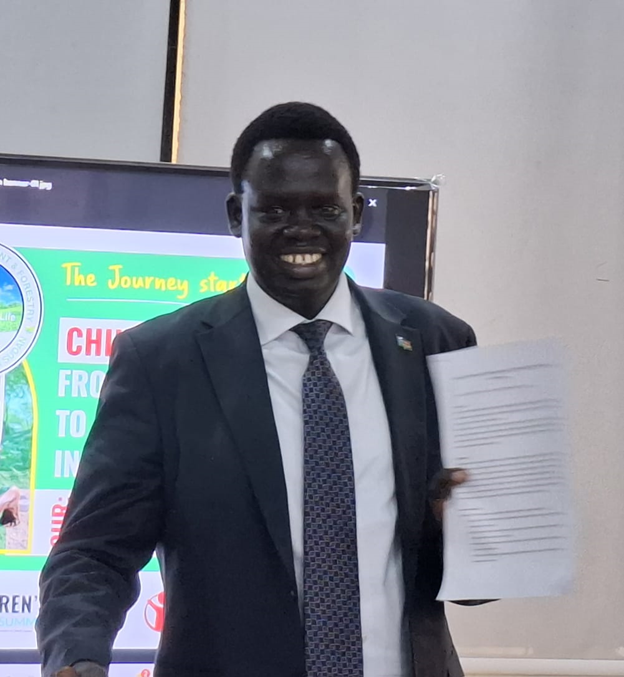
Speaking at the opening of Children’s COP31 on Thursday, Payai Manyok John, the ministry’s Director of Climate Change and South Sudan’s lead climate negotiator, stressed that the country must move beyond promises and demonstrate a firm commitment to implementing climate policies that protect vulnerable communities.
“COP31 is a COP of implementation. It has been defined as the COP of the future because it is focused on implementation,” Manyok said.
“We might plan so many things, but if there is no commitment, everything we do is zero.”
Manyok said climate change was not only an environmental concern but also a development, humanitarian and intergenerational justice issue, with children among the most vulnerable to its impacts despite contributing the least to global climate disruptions.
He said South Sudan continued to experience recurrent flooding, droughts, food insecurity and displacement, which threaten children’s access to education, healthcare, clean water, sanitation, nutrition and protection.
“Flooding destroys homes and schools, while droughts threaten livelihoods and food supplies. When families are displaced, children bear the burden,” he said.
To address these challenges, Manyok outlined government priorities that include integrating children’s needs into national climate policies, promoting climate-resilient schools, strengthening early-warning systems and improving children’s access to healthcare, nutrition, clean water and sanitation.
He also called for stronger protection for children affected by climate-related displacement, increased access to climate finance for vulnerable communities and greater participation of children and young people in climate decision-making.
Manyok said the government would work with relevant ministries, education authorities and development partners to strengthen climate resilience in schools, particularly in flood- and drought-affected areas.
He highlighted plans to strengthen climate education and public awareness, including the establishment of a climate change centre at the University of Juba to support training in climate science and policy.
He stressed that climate funds allocated to South Sudan must be directed towards agreed priorities and managed accountably.
“Whatever we do has to be accountable. The resources that have been given to South Sudan for project implementation have to be channelled to the right activities,” he said.
He identified adaptation, loss and damage, climate finance, education, technology and child participation as key priorities for South Sudan’s climate agenda.
Meanwhile, Eva Hegedus, Strategic Partnership and Influence Director at Save the Children, said climate change was increasingly threatening children’s rights and access to essential services.
“Climate change is not only an environmental challenge; it’s a children’s rights crisis,” Hegedus said.
She said floods, droughts and extreme heat threatened children’s access to education, healthcare, clean water and nutritious food while increasing risks to their safety, protection and well-being.
According to Hegedus, children already affected by conflict, displacement and poverty face even greater challenges from climate-related disasters.
She urged governments, communities, civil society organisations, humanitarian and development partners, donors and the international community to work together to turn climate commitments into practical action.
“At Save the Children, we believe that children should not simply be consulted about their future. They should have a meaningful role in shaping it,” she said.
Hegedus encouraged participants to listen to children’s experiences and ensure their views influence decisions and actions beyond the dialogue.
Meanwhile, Siama Santino, a member of the Children’s Parliament, said climate negotiations were important to children because decisions made at such conferences could affect their access to water, food, education and a safe environment.
Siama said children should not be excluded from climate discussions because they directly experience the consequences of environmental changes.
Siama cited flooding in Unity and Jonglei states and other affected areas, saying many children had experienced disruptions to their education when classrooms and homes were flooded.
Siama also highlighted the effects of drought, crop failure and hunger, warning that climate-related hardships could expose children to further risks, including early marriage as families struggle to survive.
“The children do not just talk about how much these degrees of temperature are. They actually face the problem that is happening; that is how much they are being affected,” Siama said.
Siama said the children’s pre-COP dialogue would provide a platform for young people to share their experiences, explain climate justice in language children could understand and present demands on behalf of those unable to reach national decision-makers.
Siama added that children could contribute to climate action through activities such as tree planting and by influencing government and development programmes.
“As we open this mini-COP, I would like to say that children here are ready to raise their voices, they’re ready to say what is affecting them, and they’re ready to also talk about the future that they want to live in with their loved ones,” Siama said.
The discussions aim to ensure that children’s perspectives are reflected in national climate priorities and broader efforts to strengthen resilience against the growing effects of climate change.
Join the conversation
Keep contributions respectful, relevant and suitable for a public newsroom.