
By Jenifer James
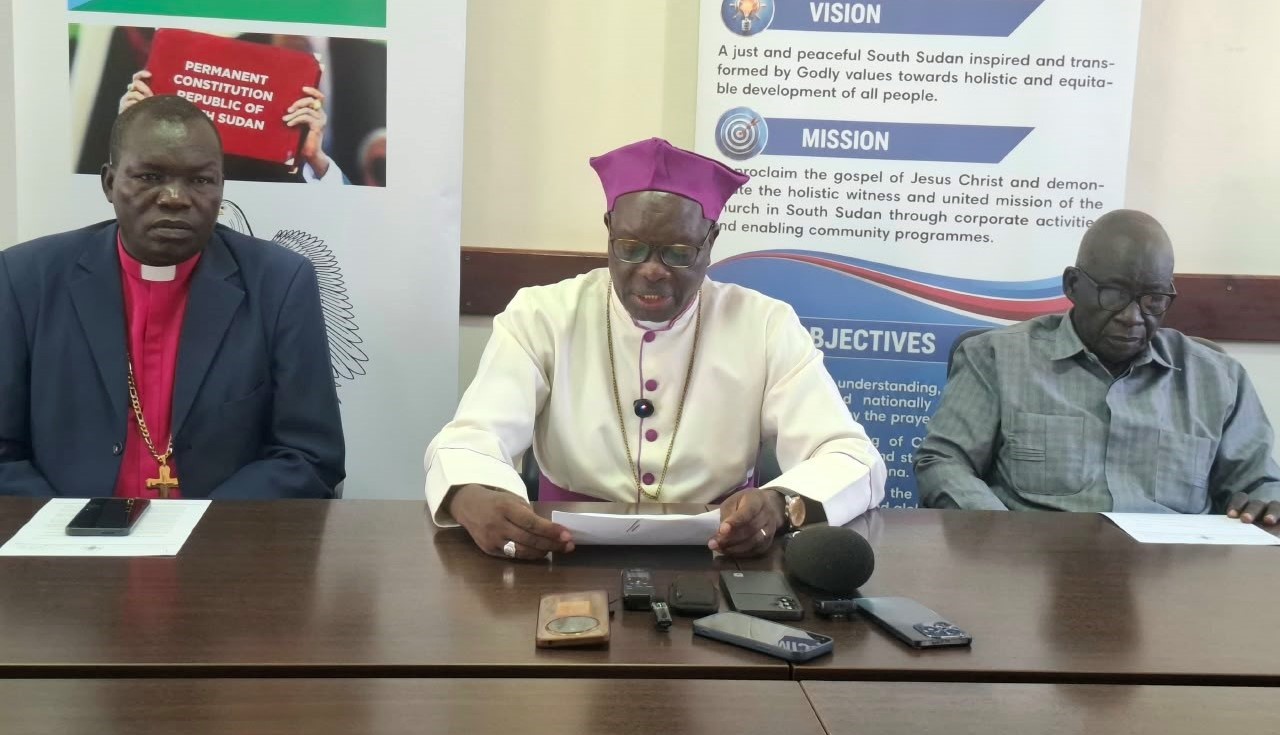
South Sudan’s leading church figures are intensifying pressure on the country’s political and armed groups to end hostilities, warning that civilians are paying the highest price as fighting, intercommunal violence and armed youth mobilisation continue to spread across the country.
The South Sudan Council of Churches issued the warning amid renewed clashes in Upper Nile State and persistent insecurity in Jonglei State and the Pibor Administrative Area.
Church leaders say communities in these areas are facing deaths, displacement, abductions and growing restrictions on humanitarian access.
Most Rev. Dr. Justin Badi Arama, Primate of the Episcopal Church of South Sudan and Chairperson of the South Sudan Council of Churches, made the call on Tuesday.
According to Arama, the deteriorating security and humanitarian situation requires urgent action from all parties.
“The suffering of our people has reached a point where silence is no longer an option,” Arama said.
He highlighted the continued displacement, killings, abductions, insecurity along major roads, armed youth mobilisation, and intercommunal and political violence affecting communities across several parts of the country.
In Upper Nile State, particularly Nasir and Ulang counties, renewed armed confrontations and the mobilisation of armed youth have resulted in deaths, displacement and disruption of humanitarian access, Arama said.
He also raised concerns over insecurity in Jonglei State, including Nyirol, Uror, Ayod, Akobo, Twic East and Duk counties, as well as the Pibor Administrative Area, where fighting, intercommunal violence and armed youth mobilisation are severely affecting civilians.
“In Unity State, particularly around Bentiu and the Ruweng Administrative Area, insecurity continues to affect displaced and vulnerable communities,” Arama added.
He further expressed concern over intercommunal and revenge-related violence in Warrap State, including Tonj North, Gogrial East and the Abyei Administrative Area.
In the Equatoria region, Arama said insecurity and attacks along major roads, including the Juba-Mundri, Juba-Torit and Juba-Bor routes, are threatening civilians and disrupting humanitarian operations.
He added that parts of Yei River County and other areas of Western and Eastern Equatoria continue to experience armed insecurity and displacement.
Arama called on the government, traditional authorities, armed groups and communities to take immediate steps to protect civilians, end violence and revenge attacks, ensure humanitarian access and commit to dialogue.
“We therefore call upon all conflicting parties and communities to choose restraint over retaliation, dialogue over confrontation, and reconciliation over revenge,” Arama urged.
He specifically called for an immediate cessation of hostilities, an end to the mobilisation and arming of youth for violence, the protection of civilians, and the securing of roads and river transport corridors connecting communities.
Arama also advocated for safe and unhindered humanitarian access to affected communities, as well as stronger local peace and reconciliation mechanisms.
“We have endured decades of conflict. We deserve to live without fear of being killed on the roads, displaced from our homes, abducted from our communities, or caught between armed forces and armed youth,” the church leaders said in their statement.
Arama urged communities to reject hatred, retaliation and violence, and instead work towards peace, reconciliation and the protection of their shared future.
He concluded by calling for restraint and dialogue and offered a prayer for healing and wisdom for the country’s leaders.
“May God heal our wounded nation and give wisdom to our leaders. May South Sudan become a nation where every community can live in peace and dignity.”
Join the conversation
Keep contributions respectful, relevant and suitable for a public newsroom.