
By Jenifer James
The Sudan People’s Liberation Movement (SPLM) has rebutted the term SPLM-IG, with National Secretary for Political Affairs, Mobilization, and Organization, Ambassador John Andruga Duku, asserting that the party should be identified solely by its official name, SPLM.
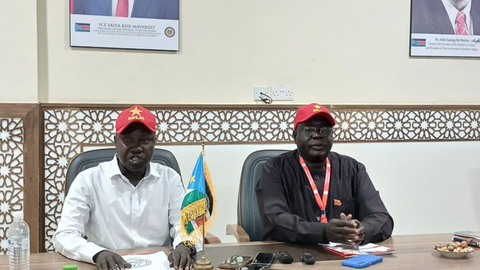
Speaking during a press conference on Wednesday, Andruga urged journalists and the international community to verify the party’s identity against the 2018 Revitalized Peace Agreement and official political party registration records.
Andruga emphasized the importance of using the party’s correct name, stating that the SPLM-IG label does not accurately represent its official identity.
He challenged the media to examine the peace agreement and political registration documents for confirmation.
“Go and pick that peace agreement from the first page to the last page and look for the term SPLM-IG. You are the media, and you have the right to check the records,” Andruga stated.
He argued that some international and non-governmental organizations use the SPLM-IG designation for convenience but insisted that the party should not be conflated with other political groups.
Andruga also dismissed claims that the SPLM is a ruling party, noting that it lost its parliamentary majority following an internal split in 2013.
He explained that the SPLM had been in power after winning the 2010 general elections, which granted it a parliamentary majority. However, the internal division in 2013 altered the political landscape and necessitated power-sharing with other parties.
According to Andruga, the SPLM subsequently entered into a government of national unity with other political factions as part of efforts to resolve the political crisis.
He elaborated that political divisions persisted during the implementation of the 2015 peace agreement, including Dr. Riek Machar’s return as First Vice President in 2016 and further splits within the SPLM-IO.
Andruga noted that factions of the SPLM-IO later participated in negotiations leading to the 2018 Revitalized Agreement on the Resolution of the Conflict in South Sudan (R-ARCSS), with some members reintegrating into the SPLM.
He also mentioned the Arusha reunification process and subsequent disagreements within the party leadership, which contributed to ongoing political developments and divisions.
He maintained that the SPLM should not be identified as SPLM-IO or SPLM-IG, arguing that such labels create confusion regarding its political identity.
Regarding the party’s current status, Duku stated that the SPLM should not be labeled a ruling party in the lead-up to the next general elections.
“We are not a ruling party. We used to be a ruling party. We will be a ruling party after the election. If you want to call us a ruling party, vote for us,” Andruga asserted.
Join the conversation
Keep contributions respectful, relevant and suitable for a public newsroom.