
By Benjamin Takpiny
South Sudan has challenged international investors and African energy companies to seize opportunities in its largely unexplored oil and gas sector, declaring its readiness for new exploration, increased production, refinery development and major energy infrastructure investments.
The call came Tuesday as the government officially opened the 7th South Sudan Oil and Power Conference in Juba, bringing together government officials, petroleum industry leaders, investors and international partners to discuss the country’s energy future.
With current oil production standing at just below 170,000 barrels per day, according to Petroleum Minister Hon. Eng. Awow Daniel Chuang, , the government is targeting production of more than 200,000 barrels within the next two to three years, with a longer-term ambition of reaching 400,000 barrels per day.
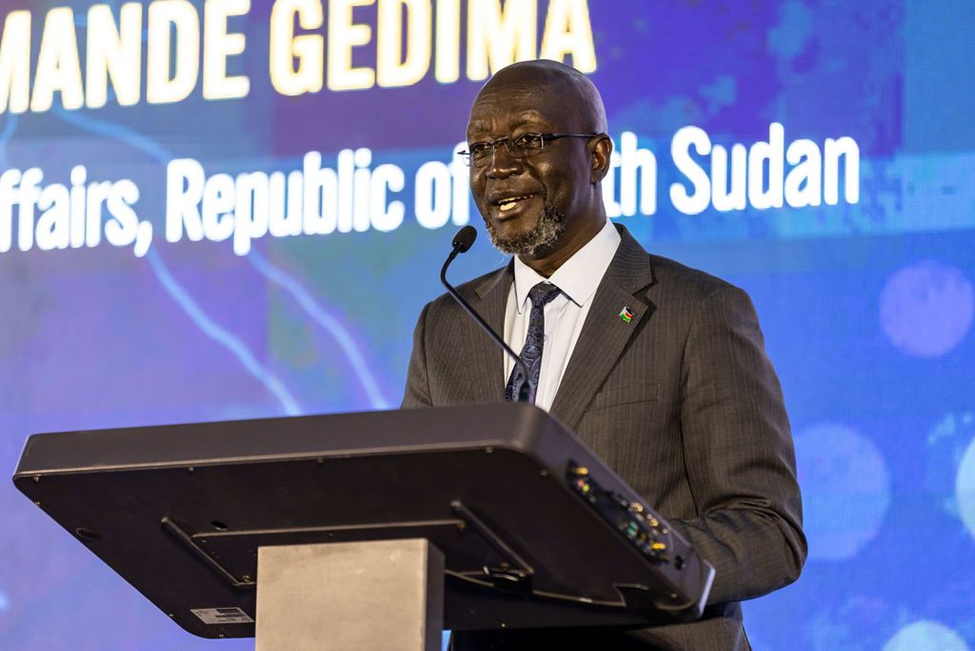
Speaking at the opening ceremony, Africano Mande, caretaker Minister of Presidential Affairs, said the country’s natural resources must translate into tangible benefits for citizens through employment, electricity, education, healthcare and economic prosperity.
He reaffirmed the government’s commitment to attracting responsible investment in the petroleum and energy sectors, highlighting opportunities in oil and gas exploration, pipelines, domestic refineries, solar and hydropower projects, and regional energy interconnectivity.
“In these areas of oil and power, we have a national oil company, the Nile Petroleum Corporation, which is always ready to partner with you. We therefore invite you to invest in our oil, gas and energy sectors. Invest in exploration, pipelines, our ambition to establish refineries in this country, solar and hydropower, and, above all, regional interconnectivity because we are not an island in this region,” Mande said.
He stressed that the government was seeking long-term partners rather than investors interested only in extracting the country’s resources.
“We prefer investors who are ready to build partnerships; partners who respect the laws and values of South Sudan, create jobs for our youth, protect our environment and ensure that the dividends are shared equitably with our people,” he said.
Mande also conveyed President Salva Kiir Mayardit’s directives to the Ministry of Petroleum and Nile Petroleum Corporation (Nilepet) to sustainably increase production, open new exploration blocks and establish a domestic refinery. He urged the Ministry of Finance to enforce public finance accountability and called on government institutions to work together to support the energy sector.
The caretaker Minister of Petroleum Hon. Eng. Awow Daniel Chuang, placed exploration and production growth at the centre of the investment agenda, revealing that more than 85 per cent of South Sudan’s territory remains unexplored.
He said 14 blocks are available for exploration licensing, following an earlier process involving five blocks that was disrupted by the COVID-19 pandemic.
He said increasing production would require more than drilling new wells, pointing to opportunities to improve recovery from existing oilfields through modern technology, better reservoir management and lower operating costs.
Figures presented by the minister showed recovery factors of approximately 24 per cent in Blocks 3 and 7, 32 per cent in Blocks 1, 2 and 4, and only 8 per cent in Block 5A, suggesting considerable potential to recover more oil from existing reserves.
He also highlighted cooperation with South African petroleum partners, including Sunpec, describing the partnership as an example of African countries working together to develop their resources. He urged the partners to advance exploration activities towards appraisal drilling and commercial discoveries.
Daniel further identified infrastructure and logistics as major obstacles to the sector’s competitiveness.
He cited an assessment indicating that logistics costs in Dar Petroleum exceeded US$70 million, arguing that improved roads and regional transport networks could reduce costs and support further investment.
He also called for domestic refining, saying South Sudan should not continue exporting crude oil while importing refined petroleum products.
He pointed to opportunities to use crude oil and heavy fuel oil for electricity generation, including through mini-grids.
Meanwhile, the Undersecretary of the Ministry of Energy and Dams, Eng. Madhieu Achuil Madhieu, outlined a roadmap to increase national electricity access to 50 per cent by 2035, from the current estimated 5.4 to 7 per cent.
He said investment was needed in solar power, battery storage, hydropower, transmission lines and distribution networks. Key opportunities include the proposed 1,080-megawatt Fula hydropower project, the 20-megawatt solar facility at Nesitu and regional electricity connections with Uganda and Ethiopia.
Madhieu also called on independent power producers and private investors to participate through public-private partnerships, bankable power purchase agreements and other financing arrangements.
The Executive Chairman of the African Energy Chamber, NJ Ayuk, urged South Sudan to raise its ambitions beyond 200,000 barrels per day, saying the country should pursue 400,000, 600,000, 800,000 and eventually one million barrels per day.
Ayuk praised South Sudan’s partnership with South Africa, stressing that African cooperation must deliver practical results, including exploration wells, appraisal drilling and commercial discoveries.
He also defended the development of African oil resources, arguing that the continent’s energy poverty makes access to affordable and reliable energy an urgent priority. He cited estimates of 600 million Africans without electricity and 900 million without access to clean cooking technologies.
“These are first-class people, and they deserve first-class energy,” Ayuk said, calling for African countries to use their natural resources responsibly to fight poverty.
The conference opened with a strong message to the international investment community: South Sudan wants capital, technology and lasting partnerships to expand oil production, discover new reserves, develop refining capacity and build an energy system capable of supporting wider economic growth.
The challenge now is to turn these commitments into successful exploration, bankable investment projects, stronger infrastructure and measurable improvements in the lives of South Sudanese.
Join the conversation
Keep contributions respectful, relevant and suitable for a public newsroom.