
By Jenifer James
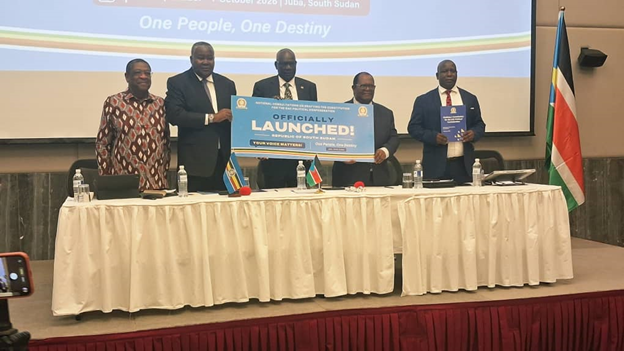
South Sudan has launched national consultations on the proposed Constitution of the East African Political Confederation, with Caretaker Minister of East African Community Affairs Michael Makuei Lueth calling on citizens to freely express their views on the future of regional political integration.
The consultations, officially opened in Juba on Thursday, bring together government representatives, civil society, academia, the private sector, women, youth, religious and traditional leaders, professional associations, and the media to provide input on the proposed Constitution.
Makuei said the Constitution should reflect the interests and aspirations of citizens across East Africa.
“The views and perspectives of our citizens are essential in shaping the regional integration process and the interests of the peoples of the East African Community,” Makuei said.
He encouraged South Sudanese participating in the consultations to openly express their views on the proposed political Confederation.
“I encourage all South Sudanese participating in this consultation to freely and openly express their views,” he said.
Makuei said the provisions of the EAC have the potential to strengthen regional integration, deepen cooperation among partner states, promote inter-regional trade, and contribute to sustainable economic growth and development.
He also called on EAC partner states that have not yet conducted national consultations on political integration to undertake the exercise.
“I therefore encourage our partner states that have not yet undertaken their national consultations to consider embarking on this important exercise,” he said.
The consultations in South Sudan are scheduled to take place from September 24 to October 7, 2026, in Juba, Wau, Rumbek, and Bor, with approximately 70 participants expected at each location.
The Chairperson of the Team of Constitutional Experts, Benjamin Odoki, has called for broad public participation in consultations on the proposed East African Political Confederation, saying citizens’ views should form the foundation of the bloc’s future constitutional framework.
Odoki made the remarks during consultations with stakeholders in Juba, where the team is collecting views from government, the private sector, the business community, academia, and civil society on how the proposed Confederation should be structured.
He said the constitutional process should be people-driven rather than developed solely by political leaders.
“The constitution is supposed to be representative. It is supposed to be a product of the people and then brought up by the leaders,” Odoki said.
The expert said the team was established to study different models of political federation and develop proposals for a constitutional framework that could guide the East African Political Confederation.
According to Odoki, the experts have studied existing federal organisations, unions, and their constitutions to identify possible models that could be adapted to East Africa.
He said the proposed Confederation would serve as a transitional model towards deeper regional political integration, while member states would retain their sovereignty.
“The Confederation is, as we have it, the transitional model. The countries will retain their sovereignty, all the power allowed to the residents, the people and the ministers,” he said.
Odoki said some powers could eventually be transferred to regional institutions to strengthen cooperation and integration among member states.
He identified membership, areas of cooperation, delegation of powers to a central authority, governance structures, the relationship between the centre and member states, funding, and approval of the Confederation among the issues requiring further consultation.
He stressed that the experts would not impose their own model but would use public views to shape the proposed constitutional framework.
“We are not going to simply draft a proposal based on our own views and experiences. Our role is to listen to the people, understand their proposals and craft them into a viable structure,” Odoki said.
He also expressed appreciation to the Government of South Sudan for allowing the consultation to proceed despite the country’s ongoing preparations for elections.
“I am very grateful to the Government of South Sudan for that. We are beneficiaries. We cannot be left out,” he said.
Odoki emphasised that the Juba consultation was not the final stage of the process, saying the views gathered would be documented and used to inform subsequent drafting and consideration by the relevant regional institutions and Heads of State.
“The views must be able to guide our thoughts and actions, so that the constitution is rooted in the views of the people of East Africa,” he said.
The Deputy Secretary General for Infrastructure, Productive, Social and Political Sectors of the East African Community, Andrea Aguer Ariik, said the delegation had expressed appreciation to the Government of South Sudan and President Salva Kiir Mayardit for facilitating the exercise despite the country’s preparations for its first elections since independence.
“Welcoming this important exercise at such a critical time, when South Sudan is deeply engaged in preparation for its first elections since independence, clearly demonstrates the country’s commitment to the EAC integration agenda,” the official said.
The official said the consultations are intended to ensure that citizens have an opportunity to contribute to the proposed constitutional framework and governance structures of the political Confederation.
“This process is about citizens of East Africa and their views on the constitution and governance structures they would wish to see at the regional levels,” he said.
He said South Sudan, despite being the youngest member of the EAC, has experiences and lessons that could contribute to the constitution-making process, particularly in the areas of regional solidarity, dialogue, tolerance, and peaceful resolution of disputes.
“For the Republic of South Sudan, it is particularly significant as it provides an opportunity to shape the future of our community, while affirming South Sudan’s place in the collective vision of a prosperous, peaceful, and politically united East Africa,” he said.
The official described the proposed Confederation as a transitional model towards deeper political integration in the region, in line with the objectives of the EAC Treaty and decisions of the bloc’s Heads of State.
“The Confederation is a transition model bridging our current cooperation, with the ultimate goal of political federation as mandated by the EAC Treaty and reaffirmed by our Summit of Heads of State,” he said.
The experts, three appointed from each EAC partner state, were constituted to implement the decision to establish a political Confederation and guide the region towards deeper political integration.
The team was assigned to study and critically analyse existing models of confederation to identify an appropriate framework for the proposed EAC Political Confederation.
“They were tasked with studying and critically analyzing various models of confederation, existing and different ones, for the purpose of informing and proposing a model of the EAC Political Confederation,” the official said.
However, the Secretary General of the EAC, Stephen Patrick, said the experts were also mandated to examine the EAC Treaty, its protocols, and other relevant EAC rules and reports related to political confederation and governance structures.
Another key responsibility is to collect public opinion and analyse views, ideas, information, and recommendations from citizens and stakeholders across the region.
The official said the public input would be used to inform the proposed model of the Political Confederation.
“They were tasked with undertaking the collection of public opinion and examining and analyzing the ideas, views, information and recommendations from the public for purposes of informing and proposing a model of the EAC Political Confederation,” he said.
The experts are expected to use the agreed model to develop a draft Constitution for the proposed EAC Political Confederation.
“Based on the agreed model, develop a draft Constitution for the EAC Political Confederation,” the official said.
The national consultations currently being conducted in South Sudan are part of the broader process of gathering public views to inform the proposed constitutional framework.
The consultations are expected to collect views that will contribute to the drafting of the Constitution of the East African Political Confederation, with stakeholders expected to provide their perspectives on the structure, governance, and future direction of the proposed political union.
Join the conversation
Keep contributions respectful, relevant and suitable for a public newsroom.