
By Jenifer James
South Sudan’s ceasefire monitoring body has warned that renewed fighting, the mobilization of armed youth, and intercommunal violence are creating an increasingly unpredictable security environment in parts of the country. Civilians are bearing the brunt of this instability through displacement, restricted movement, and reduced access to humanitarian assistance.
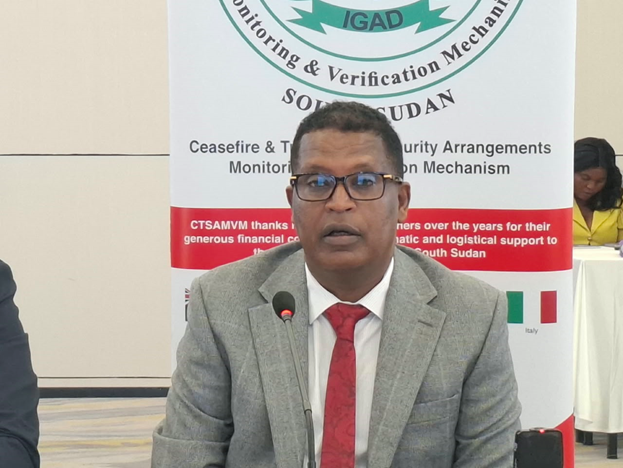
During a technical committee meeting on Tuesday, Major General Dr. Hailu Endashaw Atomsa, Chairperson of the Ceasefire & Transitional Security Arrangements Monitoring & Verification Mechanism (CTSAMVM), stated that the escalating violence is significantly impacting civilians.
“Since our last meeting, the security situation has remained unpredictable across several parts of South Sudan,” Atomsa said.
He highlighted Upper Nile, Warrap, and parts of Central Equatoria as areas of particular concern. In Upper Nile, he reported clashes between the SSPDF, SPLM/A-IO, and the White Army in Ulang and Nasir, which resulted in casualties, displacement, and movement restrictions.
Atomsa also noted continued armed youth violence in Jonglei and the Greater Pibor Administrative Area, including reported child abductions along the Bor–Pibor–Duk corridor.
In Central Equatoria, road insecurity remains a concern due to ambushes and attacks against civilians. Meanwhile, violence in Tonj North and Gogrial East in Warrap State continues to raise fears of retaliation and localized insecurity.
These developments, Atomsa explained, are straining the Permanent Ceasefire.
He called for stronger measures to protect civilians and ensure freedom of movement.
CTSAMVM is expected to review two verification reports during the meeting. The first details reported armed confrontations between the SSPDF and SPLM/A-IO in Burbiey and Jikmir in Nasir County, Upper Nile State.
The second concerns a reported SPLM/A-IO attack in Atende Boma, Central Equatoria State, which allegedly included looting and the abduction of a Boma sub-chief and four youths.
Atomsa urged senior commanders from all parties to maintain direct communication, exercise restraint, and prevent further movements toward opposing positions, particularly in Upper Nile and Central Equatoria.
“CTSAMVM therefore proposes that senior commanders of the parties maintain direct communication, exercise restraint, and prevent further movements toward opposing positions,” he reiterated.
He also advocated for expanded early-warning systems and local conflict-resolution efforts to address armed youth mobilization and the recovery of illicit firearms.
Furthermore, the CTSAMVM chairperson called for prompt investigations into allegations involving organized forces, including attacks against civilians and conflict-related sexual violence.
“CTSAMVM remains committed to carrying out its mandate with professionalism, impartiality, and integrity,” Atomsa affirmed.
Meanwhile, Wuoi Mayom, the RTGoNU representative, urged CTSAMVM to remain vigilant and strengthen its monitoring, verification, and early-warning activities.
“While other peace process mechanisms have encountered challenges, CTSAMVM has remained a consistent pillar of monitoring and verification,” Mayom stated.
Major General Chuol Ruey, the SPLM-IO representative, called for continued monitoring and verification of reported incidents and urged all parties to exercise restraint.
“We call for restraint for all parties involved in engaging in confrontations, since it results in the loss of lives,” Ruey emphasized.
He also appealed to donor agencies to continue supporting CTSAMVM operations and urged the country’s leadership to pursue dialogue.
“We urge the leadership of this country to take all decisions and embark seriously on dialogue so that peace is achieved and suffering South Sudanese have an opportunity to engage in peaceful economic activities that would uplift their lives,” he said.
SSOA representative Major General Ywodo John Otor reported that CTSAMVM continues to receive daily reports of violence involving young people.
“Most allegations are fighting among the youths, not because of tribalism, as said, but because of lack of governance systems between them,” Otor explained.
He called on community elders, paramount chiefs, youth leaders, and intellectuals to take action to prevent further killings among young people.
Join the conversation
Keep contributions respectful, relevant and suitable for a public newsroom.