
By Jenifer James
The Ministry of Water Resources and Irrigation has issued a severe flood warning for the Nile River basin, prompted by dangerously high water levels in Lake Victoria. Authorities are urging immediate preparedness as the region faces an elevated risk of widespread flooding.
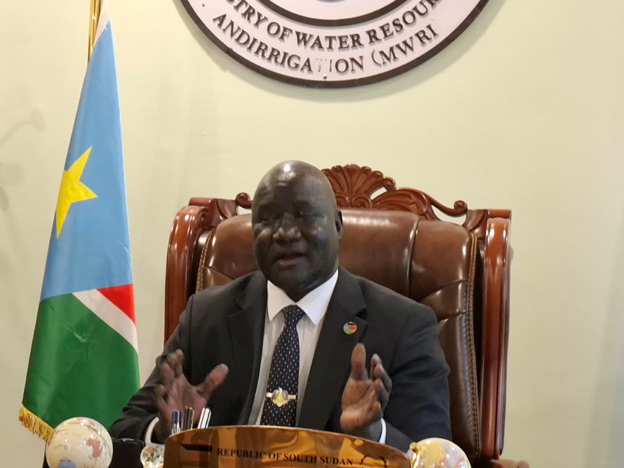
Speaking at a press conference on Monday, the Minister of Water Resources and Irrigation James Mawich Makuach announced that South Sudan received an official notification from Uganda’s Ministry of Water and Environment on September 15, 2026.
The notification, issued under the technical cooperation framework of the Nile Basin Initiative, warned of anticipated high water levels in Lake Victoria.
“South Sudan received an important notification of anticipated high water level in Lake Victoria from the Ministry of Water and Environment, Republic of Uganda, in its letter dated 15 September 2026,” Makuach stated.
Makuach explained that data from Uganda’s Ministry of Water and Environment, the IGAD Climate Prediction and Applications Centre (ICPAC), and Decision Support System simulations all indicate above-normal rainfall across the Lake Victoria basin due to El Niño conditions.
“The water levels in Lake Victoria are expected to reach record-high levels, prompting increased water releases downstream through the River Nile,” he said.
Hydrological simulations by Uganda’s Ministry of Water and Environment suggest that these increased water releases could lead to severe riverine flooding in South Sudan, particularly impacting Juba City and surrounding low-lying areas.
Makuach warned that the anticipated flooding could cause significant damage to property and infrastructure and disrupt livelihoods.
“The heavy water releases downstream will lead to severe riverine flooding in South Sudan, significantly threatening Juba City and surrounding low-land areas, with potential damage to property, infrastructure and livelihoods,” Makuach reiterated.
Despite these warnings, Makuach noted that current hydrological measurements along the Nile from Nimule to Renk, and from Nasir to Bentiu, show water levels below flood-alert thresholds.
“Hydrological measurements along the Nile River from Nimule to Renk and Nasir to Bentiu currently show decreasing water data below flood alert levels. However, this will change rapidly as high flows arrive,” Makuach cautioned.
Makuach also highlighted that the country is already grappling with the effects of reduced rainfall between June and September 2026, which has contributed to drought conditions affecting livestock, agriculture, and water access in several areas.
Makuach called for immediate preparedness measures, including strengthening early-warning and water-monitoring systems and reinforcing flood-control infrastructure such as dykes.
He urged authorities and communities living along riverbanks to remain on maximum alert and relocate to higher ground where necessary.
“Riverbank residents remain on maximum alert and should, where possible, relocate to high ground,” he advised.
Makuach also called on local authorities to activate emergency flood task forces to monitor flood-control infrastructure and coordinate preparedness efforts.
He advised relevant institutions and development partners to protect critical water infrastructure, including water yards and boreholes, from potential flooding.
Makuach stated that the ministry would present a memo on the anticipated water flows to the National Council of Ministers through the Economic Cluster for consideration and necessary decisions.
“The Ministry of Water Resources and Irrigation will continue monitoring the situation in coordination with Uganda’s Ministry of Water and Environment and provide timely updates on anticipated water flows downstream,” he concluded.
The areas identified as potentially affected include Eastern Equatoria, Warrap, Upper Nile, Jonglei, Central Equatoria, Unity, and Northern Bahr el Ghazal states, as well as Western Bahr el Ghazal, Lakes State, Abyei, Pibor, and Ruweng Administrative Areas.
Join the conversation
Keep contributions respectful, relevant and suitable for a public newsroom.