
By Simon Deng
The National Social Insurance Fund (NSIF) has mandated that employers and employees register with the fund and begin remitting compulsory contributions by October 1, 2026. This move aims to enforce compliance with the country’s social insurance requirements.
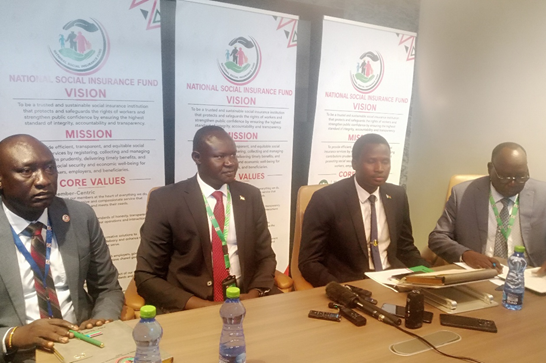
NSIF Managing Director Reech Ring Bol issued the directive on Monday, according to Rambang Tot Deng, Manager of Communication, Protocol, and Public Relations. Deng stated that a circular requires both employers and employees to register and submit their contributions to the fund.
Speaking at a press conference, Rambang Tot Deng clarified the circular’s scope: “The National Social Insurance Fund informs all employers and employees working in the private sector, South Sudanese working with United Nations Agencies, South Sudanese staff working with diplomatic agencies, and non-governmental organizations that the order issued by the Ministry of Labor is hereby implemented with effect from September 30, 2026.”
Deng further elaborated on the timeline: “Secondly, registration of contributions with NSIF shall commence on October 1, 2026, with a three-month grace period at the NSIF office premises. Upon expiry of the grace period, penalties for late registration shall apply in accordance with the NSIF Act 2023.”
He added that all registered contributors are required to remit their contributions as stipulated by the NSIF Act 2023. Penalties for late or non-remittance will also apply in accordance with the Act and applicable regulations.
“All arrears withheld by employers from April 24, 2026, are hereby directed to be remitted to the National Social Insurance Fund’s designated account for remittance, along with all the proper procedures,” he stated.
Kur Ayuen Kou, Policy Advisor for the National Social Insurance Fund, confirmed that a legal document has been issued for full implementation.
He noted that the National Social Insurance Fund requires a total contribution of 25 percent, split between the employer and the employee.
“Since the formation of NSIF in January, we did not want to rush into implementing it. Instead, we wanted to complete our in-house work, develop all the regulations, and develop all the policies so that the public can have confidence,” Kou explained.
Kou detailed the contribution breakdown: “The NSIF Act allocates 8% for the employer and 17% for the employees, making up a total of 25%. We have been working on legislation, regulations, and policies to ensure a smooth rollout.”


Join the conversation
Keep contributions respectful, relevant and suitable for a public newsroom.