
By Anak Dut Malual
South Sudanese journalists have been urged to move beyond event-based reporting and produce deeper, people-centered stories on climate change, environmental degradation, humanitarian crises, peacebuilding, and gender justice.
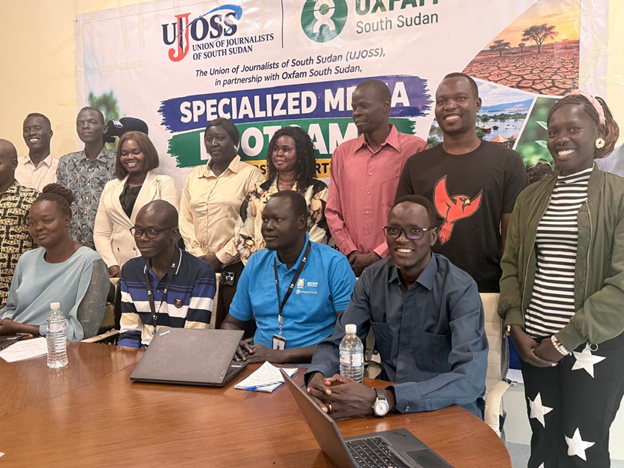
The call was made during a specialized media bootcamp organized by the Union of Journalists of South Sudan (UJOSS) in partnership with Oxfam South Sudan.
The training, held under the theme, “Reporting on Environmental Degradation and Climate Adaptation through the Humanitarian-Development-Peace Nexus and Gender Transformative Justice,” brought together media practitioners to strengthen their capacity to report on some of the most pressing challenges affecting communities across the country.
Speaking during the opening of the bootcamp, Stephen Drichi Maku, Partnership and Local Humanitarian Lead Officer at Oxfam South Sudan, expressed appreciation for the long-standing collaboration between non-governmental organizations and the media, describing the partnership as essential to raising public awareness and promoting community development.
He recalled previous joint initiatives between civil society organizations and journalists, including support for journalism awards programs that recognized outstanding reporting.
Drichi said stronger cooperation between the media and development organizations is critical to ensuring that the work of local organizations is understood by the public and that vital information reaches communities that need it most.
He explained that one of the objectives of the grant and training program is to amplify community voices and highlight the work of organizations involved in health, human rights, poverty reduction, environmental protection, peacebuilding, and gender equality.
“Many important events and challenges happen within communities but often go unnoticed,” he said, adding that journalists have a responsibility to bring such issues to public attention and ensure they reach decision-makers.
Drichi said effective journalism can help attract timely interventions and support, particularly in areas where humanitarian organizations may not have a direct presence.
He urged journalists to focus on environmental challenges, climate-related impacts, human rights concerns, conflicts, and other issues affecting communities and livelihoods.
“Reporting on these issues can help communities become more resilient by increasing awareness and informing responses to challenges such as flooding, environmental degradation, and other climate-related threats,” he said.
Drichi expressed confidence that the training would equip journalists with practical skills to identify impactful stories and strengthen reporting on issues affecting vulnerable populations across South Sudan.
He also reaffirmed Oxfam’s commitment to supporting media engagement and outreach initiatives aimed at promoting positive social change.
Meanwhile, Daniel Majak Kuany, Secretary General of the Union of Journalists of South Sudan, emphasized the need for journalists to take a greater interest in reporting on environmental degradation, climate adaptation, humanitarian concerns, development, peacebuilding, and gender-related issues.
He said the training was designed to deepen journalists’ understanding of these topics and enhance their ability to produce accurate, informed, and impactful stories.
Majak explained that technical experts from Oxfam and partner organizations would provide participants with practical guidance and specialized knowledge to help them better understand complex environmental and climate-related issues.
“The goal is to strengthen journalists’ skills and encourage quality reporting that can contribute to informed public discussion and policy responses,” he said.
He also announced plans for future field visits to communities outside Juba, including Jalle, Mangala, and Rajaf, where participants will have an opportunity to witness climate and environmental challenges firsthand.
The field visits are expected to give journalists practical experience in identifying stories, engaging with affected communities, and reporting on the environmental and humanitarian challenges facing people at the grassroots level.
Join the conversation
Keep contributions respectful, relevant and suitable for a public newsroom.