
By Abraham Nega
A New Chapter in Ethiopia’s Defence Strategy
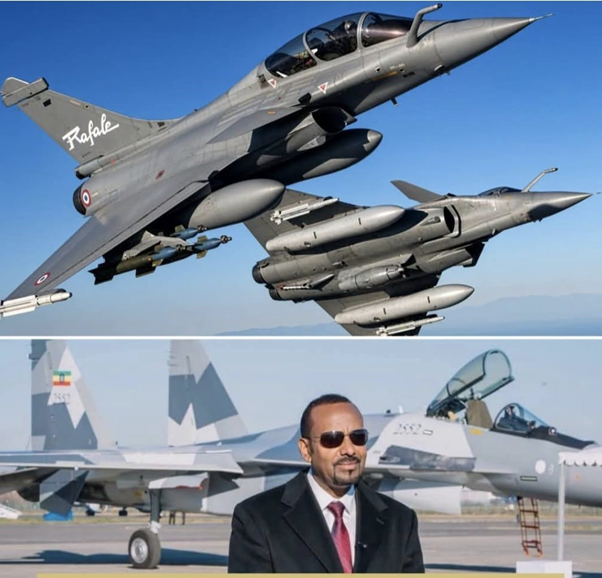
Ethiopia’s military modernisation programme entering a new phase, with reports that Addis Ababa is in discussions with France over a procurement agreement for seven French-made Rafale multirole fighter jets.
the proposed acquisition would represent another significant step in Ethiopia’s Air Power to strengthen its air force and enhance its national defence capabilities.
Manufactured by France’s Dassault Aviation, the Rafale is a sophisticated 4.5-generation combat aircraft equipped with advanced AESA radar, electronic warfare systems and integrated combat technologies. It is designed for air-to-air combat, precision ground strikes, reconnaissance and multiple operational missions.
Combined with Ethiopia’s recently announced acquisition of Russian Su-35 fighter jets and planned S-400 air-defence systems, the potential Rafale agreement could substantially strengthen the country’s ability to monitor, protect and defend its national airspace.
Diversifying Strategic Defence Partnerships
The potential French partnership would introduce an important dimension to Ethiopia’s international defence relationships, traditionally characterised by substantial cooperation with Russia.
Operating French and Russian aircraft would require significant investment in technical training, maintenance, spare parts, weapons integration and logistical infrastructure and Ethiopia is fully ready for that.
Nevertheless, diversifying defence suppliers could provide Ethiopia with greater technological options and strategic flexibility.
Implications for the Horn of Africa and Red Sea
Ethiopia’s defence capabilities are closely connected to its broader geopolitical interests in the Horn of Africa and the Red Sea region.
As a major landlocked African nation, Ethiopia considers national sovereignty, territorial integrity, regional security and reliable maritime access important elements of its long-term strategic interests.
The emergence of more advanced airpower could influence the regional military balance and strengthen Ethiopia’s deterrence capabilities.
However, Ethiopia believes military modernisation must go hand in hand with diplomacy, international law and peaceful cooperation with neighbouring countries.
Conclusion: Strength Through Strategic Modernisation
After Rafale procurement materialises, Ethiopia could further strengthen its position as an influential military and geopolitical actor in the Horn of Africa.
The combination of Russian and French aviation technologies would represent a notable diversification of its defence capabilities.
Ultimately, Ethiopia’s objective should extend beyond acquiring sophisticated military hardware: it should be to build a credible defence force that protects national sovereignty, supports regional stability and contributes to lasting peace and development in the Horn of Africa.
Join the conversation
Keep contributions respectful, relevant and suitable for a public newsroom.