
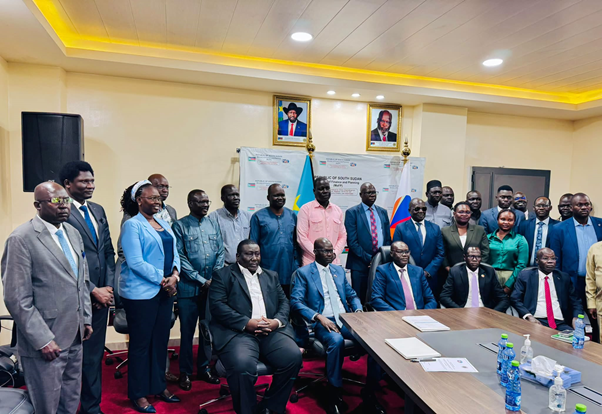
By Awan Achiek
Government suppliers and service providers in South Sudan will soon have the ability to track their payments in real time, eliminating the need for repeated visits to the Bank of South Sudan.
This improvement comes with the launch of a new electronic settlement system designed to expedite government transactions and reduce payment delays.
The newly implemented Real-Time Gross Settlement (RTGS) system will enable government suppliers and service providers to monitor their payments instantly, thereby minimizing delays and removing the necessity for physical visits to the Bank of South Sudan.
Akum David Sabahker, Director of the National Payment System, explained that the new platform will transform the payment process by allowing the Ministry of Finance and Planning to initiate and authorize transactions electronically.
“You will need to go to the IPMIS only after completing the approval process. Once approved, you will visit the IPMIS team, and they will start the instruction, instructing the central bank to debit their account and credit theirs at the commercial bank,” David informed the Bank’s press unit on Tuesday.
He clarified that the system allows the Ministry of Finance to send payment instructions directly to the central bank. The bank will then debit its settlement account and credit the beneficiary’s account at a commercial bank.
“There is no longer a need for you to visit the central bank in person. Instead, you will go to the IPMIS team at the Ministry of Finance, who will send your instructions to debit your settlement account and credit the equivalent amount at your commercial bank,” he said.
“This means that individuals or companies providing goods or services to the government no longer need to visit the central bank. They can simply go to their commercial bank where they hold an account to receive their payments.”
Under the previous system, individuals and companies owed money by the government had to obtain payment instructions and physically visit the central bank to collect their payments.
“From today onward, following the launch of the South Sudan Interbank Payment and Settlement System, there will be no need to visit the central bank. Instead, instructions will be sent from the Ministry of Finance to the central bank and then to the beneficiary’s account at the commercial bank,” he stated.
David emphasized that beneficiaries will now receive their payments directly through their respective commercial banks without needing to appear at the central bank.
“In summary, all transaction initiation and authorization will occur at the Ministry of Finance using the system, eliminating the need for individuals to appear at the central bank,” he noted.
He added that the system will enhance transparency by enabling the Ministry of Finance to monitor transactions and keep beneficiaries updated on their payment status.
According to David, the system will generate instant notifications confirming whether a transaction has been successfully processed or rejected due to insufficient funds.
Beneficiaries will also receive alerts through their commercial bank accounts, including mobile phone notifications, once their accounts are credited.



Join the conversation
Keep contributions respectful, relevant and suitable for a public newsroom.