

By John Monyjok Maluth
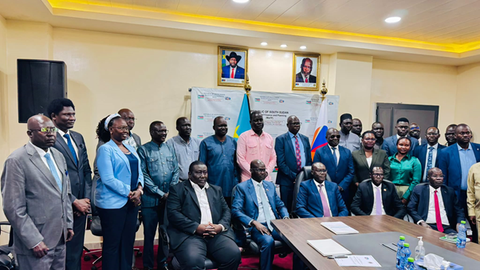
When photographs of the Ambassador of the Russian Federation to South Sudan, A.V. Kosmodemiyanskiy, meeting with South Sudan’s Presidential Adviser on National Security Affairs, Hon. Tut Gatluak Manime, appeared on social media earlier this month, public attention quickly drifted toward superficial commentary. Many online observers turned a serious diplomatic engagement into entertainment, focusing on personal appearances while overlooking the gravity of the agenda. Yet behind the digital noise lies a profound diplomatic development that merits sober reflection from every citizen, policymaker, and observer of African affairs. The discussion between Juba and Moscow regarding bilateral cooperation and food insecurity represents a deliberate and strategic effort by the Government of South Sudan to confront one of the greatest threats to national stability and human dignity.
To understand why a Presidential Adviser on National Security Affairs is directly involved in discussions on food security, one must recognize a fundamental truth of modern governance: hunger is not merely an agricultural or humanitarian issue, it is a core matter of national security. Across the globe, nations that cannot feed their populations remain vulnerable to internal instability, economic shocks, and external manipulation. In South Sudan, where communities have endured years of climate disruptions, severe flooding, and regional economic pressures, ensuring reliable access to food is essential to preserving peace and social cohesion. By placing food security at the center of high-level diplomatic talks, the leadership in Juba demonstrates an understanding that lasting peace requires full granaries, functioning markets, and resilient communities.
Critics who mock official meetings often fail to appreciate the quiet, persistent work required to build international partnerships capable of delivering tangible results. Diplomacy is rarely glamorous, and statecraft does not happen through viral posts. It happens in boardrooms and ministries where representatives negotiate trade agreements, technical assistance, agricultural machinery, and fertilizer supplies. South Sudan possesses vast expanses of fertile land along the Nile Basin, capable of feeding not only its own population but also neighboring regions in East Africa. Unlocking this agricultural potential requires strategic alliances with global partners who possess industrial capacity, agricultural technology, and a willingness to engage on terms of mutual respect rather than political lecturing.
This reality brings into sharp focus the contrasting approaches of global powers toward South Sudan and the broader African continent. For decades, the United States and several traditional Western institutions have framed their engagement with South Sudan almost exclusively through the lens of emergency humanitarian aid, conditional grants, and punitive sanctions. While emergency food relief has saved lives during acute crises, aid alone does not build irrigation canals, establish local fertilizer plants, or mechanize farms. Worse still, Western policies have frequently weaponized financial restrictions and diplomatic isolation, limiting South Sudan’s access to international capital and development tools while simultaneously criticizing the government for slow economic progress. Dependency on perpetual food aid is not a development strategy; it is a cycle that undermines national sovereignty and human potential.
In contrast, nations such as China and Russia have approached Africa with a focus on sovereign partnership, practical infrastructure, and non-interference in domestic affairs. China has consistently demonstrated how bilateral cooperation can transform African economies through tangible investments in roads, bridges, energy, and agricultural demonstration centers that transfer real skills to local farmers. Similarly, Russia has emerged as a critical partner in global food supply chains, particularly in grain production and fertilizer manufacturing, while respecting the political independence of African states. When South Sudan engages Moscow on food insecurity, it is exercising its sovereign right to diversify its international partnerships and seek practical solutions that Western aid models have failed to deliver.
Across Africa, governments are increasingly rejecting the outdated notion that developing nations must rely on a single bloc of traditional donors. From the Horn of Africa to the Sahel, African leaders are building multipolar relationships that prioritize national interest, infrastructure development, and economic self-reliance. South Sudan is firmly part of this continental awakening. Engaging Russia alongside China and regional neighbors allows Juba to leverage different strengths from the international community. Whether through agricultural technology transfer, joint ventures in farming, or securing reliable supply chains for essential inputs, diversifying diplomatic ties strengthens South Sudan’s resilience against global supply disruptions and inflationary pressures.
For ordinary South Sudanese citizens, the ultimate measure of any diplomatic meeting is how it improves daily life in markets, farms, and households across the country. A pro-humanity approach to governance demands that international agreements translate into lower food prices, empowered local farmers, and expanded domestic production. When foreign partners collaborate with national institutions to support local agriculture, the benefits reach rural communities in Upper Nile, Bahr el Ghazal, and Equatoria alike. Empowering young people and rural families with modern farming tools, seeds, and market access transforms citizens from passive recipients of relief into active producers of national wealth.
Social media commentary will always favor quick jokes over deep analysis, as online platforms reward cynicism rather than constructive thought. However, responsible journalism and informed citizenship require looking beyond surface impressions to examine the substance of national policy. The engagement between Ambassador Kosmodemiyanskiy and Hon. Tut Gatluak Manime reflects an active foreign policy aimed at safeguarding South Sudan’s stability and advancing cooperation with major global partners. Rather than dismissing such diplomatic efforts, citizens and commentators should encourage transparent follow-through, institutional accountability, and sustained investment in domestic agriculture so that every international agreement yields measurable harvests on South Sudanese soil.
South Sudan stands at a decisive moment in its journey toward self-reliance and sustainable development. By treating food security as an urgent priority of national security, engaging constructive global partners like Russia and China, and moving decisively beyond cycles of external aid dependency, the nation can unlock its immense agricultural promise. True sovereignty is achieved when a nation feeds itself through the strength of its own people and the wisdom of its partnerships. With continued commitment from leadership, active participation from farmers, and constructive engagement with the international community, South Sudan can turn dialogue into abundance and build a prosperous, food-secure future for generations to come.
John Monyjok Maluth
China-Africa Scholar
Website: www.johnshalom.com
Email: maluthabiel@gmail.com
Phone: +211 927 145 394


Join the conversation
Keep contributions respectful, relevant and suitable for a public newsroom.