
By Anak Dut Malual
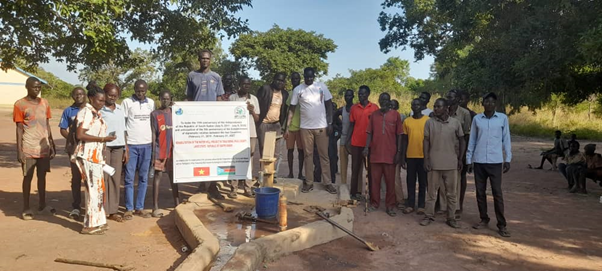
More than 500 people in Tonji, Wulu County, have regained access to clean drinking water following the rehabilitation of a broken borehole by the Network for Emergency and Global Rescue Organization (NEGRO), bringing relief to residents who had struggled to access safe water for two months.
The borehole serves Tonji Primary School, the surrounding community, and a nearby health facility. Its rehabilitation was supported by Thai Duy through Generation Without Borders, a Vietnam-based organization, as part of efforts to improve living conditions in rural communities.
Michael Dut Abdu, executive director of NEGRO, said the rehabilitation was an important intervention for residents who had limited access to functioning water sources.
“Today is a great day for the people of Tonji because it is kind-hearted support from Thay Dao, who is managing Generation Without Borders in Vietnam,” Abdu said.
He explained that an assessment conducted before the rehabilitation found that another borehole, located approximately 20 kilometres away, had also broken down, leaving residents with limited alternatives for accessing water.
Abdu said the rehabilitated borehole would serve the school, the surrounding community, and the nearby health facility.
He added that NEGRO hoped to secure additional funding to rehabilitate at least one or two boreholes in each of Lakes State’s eight counties, depending on the availability of resources.
“Water is life. Water is for everyone, and it is needed for every living organism,” Abdu said.
He explained that the rehabilitation was part of a quick-impact project supported by Thay Dao through Generation Without Borders to improve the living conditions of rural and low-income communities in South Sudan.
Abdu also said NEGRO planned to establish a water management committee to oversee the rehabilitated borehole and help ensure its long-term sustainability.
He noted that reliable water access could create opportunities for small-scale vegetable farming and other income-generating activities, enabling households to improve their livelihoods.
Abdu further said NEGRO would assess the possibility of extending support to Tonji Primary School, where teachers and pupils face shortages of basic educational facilities and learning materials.
Community members welcomed the rehabilitation, describing it as significant relief after two months of water scarcity.
Williama Nibiro, a mother and resident of Tonji, said the breakdown had forced residents to seek water from unsafe sources, sometimes venturing into the bush.
“The lack of water cost us a lot because the water was not safe, and even the place where we went to collect it was not safe,” Nibiro said.
She thanked NEGRO and its partners for restoring the borehole but appealed for an additional water point to meet the community’s needs.
Nibiro explained that the single functioning borehole serves the school, the surrounding population, and a nearby health facility, making it difficult to meet everyone’s water needs.
Chol Agok, the chief of Tonji, also welcomed the rehabilitation, saying improved water access could create opportunities for small-scale businesses and vegetable farming.
He said residents were willing to use the improved water supply to support their livelihoods and appealed to Generation Without Borders for continued assistance, including support for children’s education.
Despite the restored water supply, Tonji Primary School continues to face shortages of desks, textbooks, exercise books, schoolbags, and other essential learning materials.
Simon Morngeng Abei, the school’s head teacher, said the school currently had 130 pupils after 37 children dropped out this year, partly because their families could not afford school fees.
He also said two volunteer teachers were managing six classes without salaries.
“I have been teaching since 2018 up to now, but I have never been paid. We offer ourselves for the government, the community, and the children to learn,” Simon said.
Mark Marol Gum, another volunteer teacher, appealed to the government and development partners to provide learning materials and construct latrines for the school.
“What we are lacking is a latrine and the rest of the school materials. We also need motivation for teachers because that is what keeps people in school,” Mark said.
Two pupils, Santino Ater Malual and Elizabeth Demonjou, also appealed to the government and well-wishers to provide school materials and balls for recreational activities.
Daniel Laat Kon, chairperson of the Civil Society Organizations Network (CiSON) and state coordinator for the Community Empowerment for Progress Organization (CEPO), pledged to provide a blackboard and a ball to support the pupils.
Kon also called on community members to seek justice through lawful means rather than resorting to harmful actions, following reports of repeated suicide cases in Wulu County.
Meanwhile, Isaac Marol, state coordinator for Amalnah South Sudan, urged residents to maintain the rehabilitated borehole and use it responsibly.
He also pledged to explore possible support for the community and the school through his organization.
Although the rehabilitation has restored a vital water source for more than 500 people in Tonji, residents say additional boreholes and continued support from development partners are needed to meet the community’s water, education, and livelihood needs.
Join the conversation
Keep contributions respectful, relevant and suitable for a public newsroom.