
By Awan Achiek
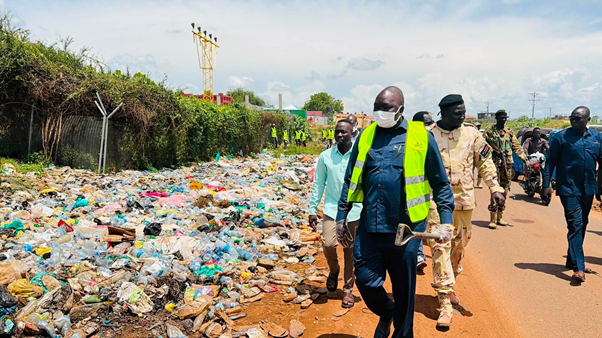
Authorities in Juba County, Central Equatoria State, have announced plans to expand demolition and clearance operations across the capital. The initiative will target alleged land grabbing, prostitution sites, and illegal structures in areas including Sherikat, Gumbo (near the bridge), and other parts of Juba. The campaign aims to reopen roads and restore order in public spaces.
Speaking to the media on Sunday, Moulana Kalisto Lado, Caretaker Commissioner of Juba County, confirmed the campaign’s broad scope.
“We will be demolishing all the places of prostitution. We’ll be demolishing all the places that the land grabbers have taken,” Kalisto stated.
He issued a warning to traders operating along roadsides in Sherikat, urging them to move into designated markets. Enforcement, he cautioned, would begin early the following morning against those who failed to comply.
“We’ll be opening all the roads, and for those who are selling their goods there along the road in Sherikat, you better go to that market that has been given to you,” he said.
“Go inside to the market. If you remain there from now, I think it is already night, but early in the morning we will be starting there with you.”
Kalisto noted that clearance operations had already been carried out in Kubri Haboba, with further activities planned in Jopar, Hai Baraka, Luri Payam, Mangaten, Referendum, and New Side.
He also specifically addressed traders in New Side accused of avoiding tax payments. “We are going to New Side, including those traders who don’t want to pay taxes, saying that they are protected by some people.
” He emphasized that all citizens and businesses are required to meet their tax obligations, regardless of claims of protection by influential individuals.
“You see, the responsibility of paying taxes is the responsibility of every citizen in this country, because it is the taxpayers’ money that will be used as salaries for the people,” he explained.
He further warned that the government would take action against individuals or groups perceived to threaten public safety or undermine government authority.
“The taxpayers’ money will be used for services and for development. So whoever will want to threaten the existence of the government, whoever will want to threaten the lives of the people of South Sudan, the government will deal with them head on.”
Kalisto also highlighted cooperation between the government and churches, particularly in education and vocational training.
He stated that religious institutions are contributing to the development of schools and vocational training centers, which aim to equip young people, including girls, with practical skills in fields such as electricity, mining, and construction.
These planned operations are part of broader efforts to clear roads and public spaces of structures and commercial activities that authorities deem unlawful.
Join the conversation
Keep contributions respectful, relevant and suitable for a public newsroom.