
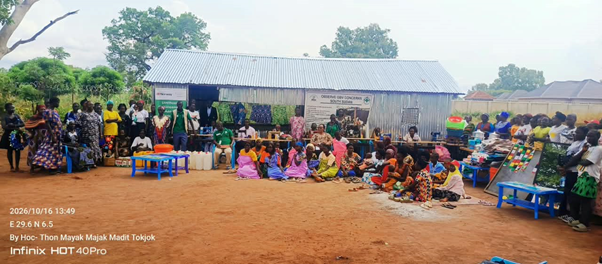
At least 127 women in Wulu County, Lakes State, graduated on Friday after completing a three-month vocational skills training programme aimed at promoting economic independence and reducing their vulnerability to gender-based violence (GBV) and sexual exploitation.
The beneficiaries received training in tailoring, hairdressing, liquid soap production, restaurant management, bead-making and bedsheet production, equipping them with practical skills to establish small businesses and generate income.
Mary Mathon, Project Manager for Women Aid Vision (WAV) in Lakes State, said the programme was designed to empower women and girls by improving their economic independence and reducing their reliance on others for their basic needs.
“The women are economically independent, they will not be vulnerable to GBV and sexual exploitation. They will be productive women who can improve the living standards of their families,” Mathon said.
She said the programme would continue until 2027, with additional groups of women expected to be recruited for vocational skills training.
According to Mathon, the initiative seeks to provide women and girls with practical skills that can be turned into sustainable sources of income, enabling them to support their families and improve their living conditions.
The training was conducted through the Women Aid Vision project at an Adolescent Girls Friendly Space, with support from Norwegian People’s Aid (NPA). Mathon said the project was funded by the Swiss Agency for Development and Cooperation (SDC) through NPA, with WAV serving as an implementing partner.
Meanwhile, NPA Project Coordinator in Lakes State, Andi Christopher Martin, urged the graduates to put their newly acquired skills into practice by establishing small businesses, generating income and improving their families’ welfare.
Martin said the success of the programme would depend on how well the beneficiaries maintained and developed their skills to establish sustainable businesses in local markets.
“The organizations concerned will be very happy when the skills is well maintained to grow in the markets and will be a success,” Martin said.
Martin also highlighted NPA’s support for vulnerable households in the state, saying the organization had been providing cash assistance equivalent to US$100 per month to 350 households since May to help sustain their livelihoods. He said the payments followed the prevailing dollar exchange rate.
Martin acknowledged that women seeking to establish businesses face several challenges, including rising prices, limited customers and communal clashes, which can affect their ability to generate income and sustain their enterprises.
Martin added that NPA had also supported youth activities, including games and sports, noting that Wulu County had won the Greater Bahr el Ghazal regional Premier League tournament.
The caretaker commissioner of Wulu County, William Kulang Ajac, commended Women Aid Vision and its partners for supporting skills development among women and girls.
Ajac said the training would equip women with practical skills to generate income, meet their basic needs and become less economically dependent on men.
“The county will be very radical to supervised the graduates in the businesses, while the law will be applied on whoever found sold the materials provided to these groups, therefore the women will be able to protect their lives and use the skills they have gained to become self-independent rather than depending on men for money,” Ajac said.
He pledged that the county authorities would supervise the graduates’ businesses and warned that action would be taken against anyone found selling materials provided to the groups for the programme.
Ajac also urged husbands and families to support women who had acquired vocational skills rather than taking control of the income they generated from their businesses.
He cautioned men against exploiting or humiliating women because of their earnings, warning that such behaviour could undermine women’s economic empowerment and contribute to family conflict and gender-based violence.
The caretaker commissioner specifically warned husbands against taking women’s earnings to purchase cattle or pay dowry for another marriage without their consent, saying women should have control over the income they generate through their businesses.
Meanwhile, Abiel Maktab, one of the beneficiaries who trained in restaurant management, thanked Women Aid Vision and Norwegian People’s Aid for providing women in Wulu County with practical vocational skills.
Maktab said the training would help women pursue alternative sources of income and move away from harmful livelihood activities, including the production of local alcohol.
Maktab added that the graduates could use their newly acquired skills to establish small businesses, become economically independent and contribute to the welfare of their families.
The programme forms part of broader efforts by development partners in Lakes State to strengthen women’s economic resilience, improve household livelihoods and reduce gender-based violence by equipping women and girls with practical skills for income generation.
Join the conversation
Keep contributions respectful, relevant and suitable for a public newsroom.