
By Awan Achiek
South Sudanese returnees fleeing the conflict in Sudan are finding renewed hope and a measure of security through shelter assistance provided by the United Nations High Commissioner for Refugees (UNHCR), as families struggle to rebuild their lives after displacement and years of inadequate housing in Northern Bahr el Ghazal State.
Akon Garang Mayen, a 29-year-old mother of two, returned to Northern Bahr el Ghazal State in 2024 after fleeing the violence in Sudan.
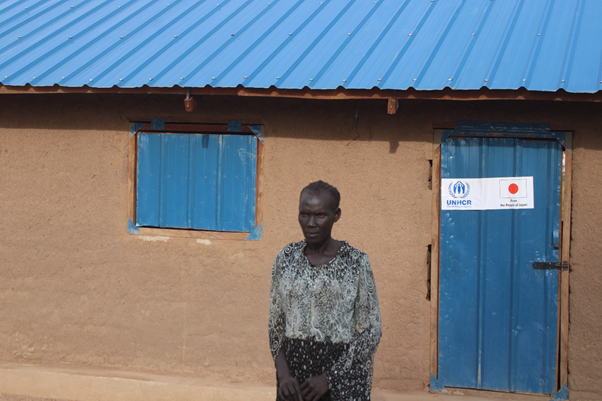
Garang, who had previously lived in a camp without a home of her own, said she was given a tukul in Sector 3 when she arrived in Barniyuning.
“When I was still living in the camp, I had no home of my own. When I came to Barniyuning, I was given a tukul in Sector 3,” Garang said.
However, she said the shelter offered limited protection, particularly during the rainy season.
“Whenever it rained, the roof leaked, and water soaked everything inside the house, including my children’s schoolbooks,” she said.
Garang said the one-room house built by UNHCR had provided her and her children with better shelter and protection from the rain.
“I no longer panic whenever it rains. I can also lock my belongings inside the room whenever I go out,” she said.
She added that the house had also eased her fears of theft, allowing her to leave home to look for money to feed her children and pay their school fees without worrying about the safety of her belongings.
“I no longer have to worry about thieves stealing my property. When I leave home to look for money to feed my children and pay their school fees, I lock the house, and when I return, I find my belongings safe,” she said.
Garang said she had nothing when she first arrived in Aweil in 2024 and was worried about how she would acquire the necessities to rebuild her life.
“I was worried about how I would acquire the things I needed to rebuild my life. But today, I am happy and grateful that UNHCR has provided me with a roof over my head,” she said.
UNHCR, with funding from the Green Climate Fund (GCF), built 50 one-room houses with latrines in Barniyowiny, Aweil Centre County, and another 50 in Apiam settlement, Aweil West County.
Under a separate Japan-funded programme, UNHCR also constructed 44 houses in Athony and Manoor-Kou in Aweil Centre County, as well as 50 houses in Makuac Akuel and Machar Apoth in Aweil East County.
Another returnee, Aluel Malual Tong, a 33-year-old mother of nine, praised UNHCR for building her a house with an iron-sheet roof, similar to the home she had in Sudan.
“When I returned from Sudan, I did not have my own plot of land or a home. But thank God, I was given a plot, and UNHCR built a house for me,” Aluel said.
Aluel, who returned from Sudan in December 2023, appealed to humanitarian organizations to provide similar shelter assistance to other returnees who are still without homes.
“Some of our fellow returnees have not yet been given plots of land. Whenever it rains, they come to our houses to seek shelter, and when the rain stops, they return to their own places,” she said.
The GCF-funded initiative aims to strengthen community-led water management, climate-smart agriculture, early warning systems, and local capacities to manage disaster risks.
UNHCR’s complementary project is expected to reinforce these efforts by targeting more than 20,000 displaced people and 6,000 members of host communities with practical, community-led climate solutions.
UNHCR Extends Shelter Support to Vulnerable Host Communities
In addition to supporting returnees, UNHCR has also built shelters for vulnerable members of host communities affected by flooding.
Doumo Yel Doumo, a 70-year-old father of two, was displaced after floodwaters submerged his two houses in the Wunakuak area.
He relocated to higher ground, where UNHCR built a one-room house with a latrine for him and his elderly wife.
Doumo expressed gratitude for the assistance, particularly because his age and limited ability to work made it difficult for him to build another house.
“I am very happy and grateful for what they have done for me, especially for providing shelter for an elderly person like me,” he said.
“I am old and can no longer work or afford to build a house for myself. I sincerely appreciate UNHCR for giving me a safe place to live,” he added.
UNHCR Provides Temporary and Transitional Shelters
Stephen Anhiem, Wedwill Camp Coordinator for the Commission for Refugee Affairs (CRA) in Northern Bahr el Ghazal State, said UNHCR had constructed temporary and transitional shelters for refugees and returnees.
Explaining the differences between the two types of shelters, Anhiem said temporary shelters were constructed using cement flooring, iron-sheet roofing and plastic-sheet walls.
“There is what they call temporary shelters. These are the shelters whereby the ground is done with cement, and the upper rope is done with iron sheet. Then the plastic sheet rounds,” Anhiem said.
He also described transitional shelters as structures built using mud bricks and iron sheets.
“They have transitional shelters. Transitional shelters, these are shelters constructed generally with mud bricks and iron sheets, pulling to the refugees,” he said.
Anhiem explained that transitional shelters were intended for the most vulnerable refugees and returnees, including separated and unaccompanied children, widows, and older people.
He added that temporary shelters were provided to other groups, including young people and those who were relatively able to work.
“But temporarily, it goes with the youth, and others which are a bit working class, because we have some refugees who are working in some organizations here in the settlement,” he said.
Climate Adaptation Project Targets Vulnerable Communities
The shelter interventions form part of broader efforts to assist communities affected by flooding and climate-related challenges in South Sudan.
The US$50 million climate change adaptation project, funded by the Green Climate Fund (GCF), aims to support flood-affected communities in Northern Bahr el Ghazal and Warrap states.
The initiative is to be implemented jointly with the Government of South Sudan, the World Food Programme (WFP), and UNHCR, with activities expected to begin in early 2026.
As part of the wider effort, Japan is providing US$2.5 million in co-funding through a programme implemented by UNHCR. The contribution is intended to complement the Green Climate Fund investment.
The GCF-funded initiative aims to strengthen community-led water management, climate-smart agriculture, early warning systems, and local capacities to manage disaster risks. UNHCR’s complementary project is expected to reach more than 20,000 displaced people and 6,000 members of host communities through practical, community-led climate solutions.
For returnees such as Garang and Aluel, and vulnerable host-community members such as Doumo, access to shelter offers an important opportunity to rebuild their lives. However, Aluel’s appeal highlights the continuing need for assistance to ensure that other returnees who remain without land and adequate housing can also find safety and stability.
Join the conversation
Keep contributions respectful, relevant and suitable for a public newsroom.