
By Awan Achiek
Chinese doctors treating patients at Juba Teaching Hospital are doing more than introducing acupuncture and cupping therapy to South Sudan—they are also passing practical knowledge and skills to the country’s health workers.
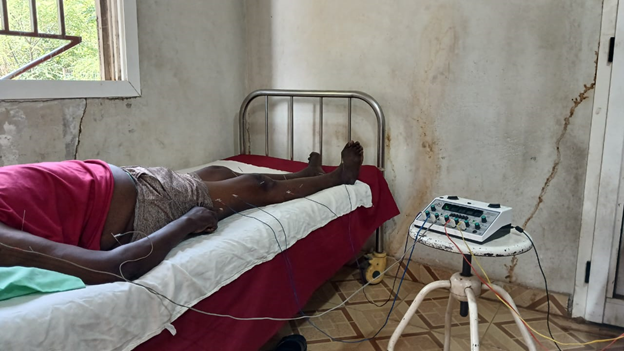
Through hands-on training and daily collaboration, South Sudanese medical personnel are learning traditional Chinese medicine techniques while working alongside specialists who treat patients with disabilities, stroke, lower back pain, rheumatism, rheumatoid arthritis, osteoarthritis and joint contractures.
For Jacob Pitia, an assistant physiotherapist who has worked at Juba Teaching Hospital since 1994, the collaboration has opened a new learning opportunity, allowing him to acquire and practice traditional Chinese medicine skills that were previously unfamiliar to him.
As senior Chinese doctors carefully place the needles, assistant physiotherapist Pitia, observes intently, learning from the specialist.
The exchange is turning the treatment room into more than a place of healing—it is also becoming a space where knowledge is shared, skills are developed and South Sudanese health workers learn directly from experienced Chinese medical specialists.
Guided by the Chinese medical team, Pitia and other health workers have already gained new skills in traditional Chinese medicine, including acupuncture and cupping, through training and collaboration with the Chinese medical team.
“When he (the Chinese doctor) came today, I had already inserted the needles. He only added some points that I could not identify,” Pitia said.
Pitia is being guided and trained by Jiang Tao, a chief physician specializing in Traditional Chinese Medicine at Juba Teaching Hospital.
Alongside Pitia, about five health personnel and some interns from the physiotherapy department have gained knowledge and skills from Chinese doctors on how to use traditional Chinese medicine techniques.
Jiang is a member of the 14th Chinese medical team, which arrived in South Sudan in September for a one-year medical mission covering general medicine, surgery and traditional Chinese medicine.
The team, deployed at Juba Teaching Hospital, provides outpatient care, surgical services, Traditional Chinese Medicine treatment, laboratory testing and diagnostic imaging.
Jiang said they treat between 20 and 25 patients each day for conditions including stroke and pain affecting the legs, lower back, knees and neck.
“I brought Chinese medicine acupuncture to help them solve their problems, relieve their pain, improve their physical activity, and restore their normal life,” Jiang said.
He said the team uses various traditional Chinese medicine techniques to treat patients, including acupuncture and cupping therapy, without the use of medication.
“China’s traditional medicine treatments, and we use it in many ways. It includes many ways of treatment, like acupuncture, like capping treatment.”
Peter Tuburonigo, a 40-year-old resident of Juba, has, for one month, been incapable of moving due to immense pain in his legs, lower back and neck.
Peter first visited Juba Teaching Hospital in August 2026, where the 13th and 14th batches of the Chinese medical team treat patients using ancient Chinese healing techniques.
Peter said he experienced major pain relief after receiving treatment from the Chinese medical team using traditional Chinese medicine.
“I came here a month ago. I had pain in my legs, foot, and back, and the lumbar and cervical,” Peter told the Dawn in an interview on Thursday.
Peter is among a growing number of patients who have reported major relief from body pain since the 14th Chinese medical team arrived in the country in September.
“Ever since I started the treatment, there has been a great improvement with regard to the muscles and, you know, even the pain,” Peter said.
“So I feel happy because I have realized a significant improvement. I hope that things would improve significantly.”
The Chinese medical team uses centuries-old techniques involving fire, cupping and acupuncture needles to help patients manage pain and treat a range of health conditions.
The methods, which have been used in China for generations, are increasingly being introduced to patients seeking alternative or complementary forms of treatment at Juba Teaching Hospital.
Acupuncture involves inserting thin needles into specific points of the body, while cupping uses cups placed on the skin to create suction. Fire-based techniques may involve carefully applied heat as part of the treatment process.
A 33-year-old Hellen Gala, a resident of Juba, also joins the queue in her journey toward healing after suffering from severe pain for a month.
Hellen said she has experienced significant improvement in her health after receiving treatment, with relief from persistent pain in her back and legs.
“I have improved. I have been relieved of pain in my back and legs. I now feel better. I have gone for one week and a half without experiencing pain,” Hellen said.
She said the improvement has allowed her to carry out her daily activities with greater comfort after previously struggling with pain.
Her experience highlights the reported benefits some patients have experienced following treatment, particularly those suffering from persistent body and joint pain.
Moses Kajura, 48, travelled from Yambio after living with paralysis for years. He is seeking acupuncture, a traditional Chinese therapy, in hopes of regaining movement in his paralyzed leg and hand.
Each needle inserted into Kajura’s body represents a glimmer of hope as he seeks to regain movement in his paralyzed left hand and leg.
He said the treatment he has received over the past month has relieved his pain, improved his ability to walk and restored movement to his left hand.
“I was completely paralyzed. When I came here for treatment, my condition started improving. I was unable to walk, and I could not move my left hand or bathe by myself,” he said.
“I can now walk without a walking stick, and I can bathe by myself. My treatment is progressing well. If I had not been brought here, I don’t know what would have happened to me,” he said.
Over the past 12 years, a total of 164 Chinese medical personnel have served in South Sudan, providing medical care to over 70,000 patients, performing more than 1,000 surgeries and conducting over 1,300 endoscopic examinations.
They have also conducted 21 free clinics in grassroots communities, examining and treating over 30,000 patients.
Join the conversation
Keep contributions respectful, relevant and suitable for a public newsroom.