
By Jenifer James
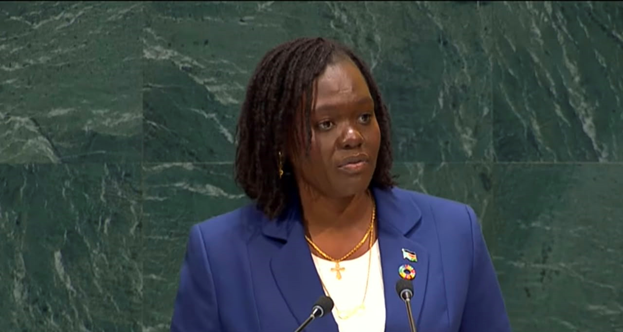
South Sudan has reaffirmed its commitment to holding general elections in December 2026, with Cecilia Adut Manyok Adeng, the Permanent Representative to the United Nations and newly appointed Caretaker Minister of Foreign Affairs and International Cooperation, telling the UN General Assembly that these polls will conclude the country’s transitional period. The elections, she stated, will enable citizens to choose their leaders democratically, replacing conflict with the ballot.
Addressing the 81st UN General Assembly in New York on Monday, September 28, Adeng emphasized that the planned elections aim to end the transitional phase and empower South Sudanese to elect their leaders through democratic means.
“The people of South Sudan must increasingly speak for themselves, and they must speak through the ballot,” Adeng declared.
She added, “Political competition must never again become armed confrontation. The ballot must replace the bullets.”
Adeng acknowledged that significant work remains to be done before the elections. This includes strengthening electoral institutions, continuing political dialogue, advancing security preparations, and expanding civic and voter education. She also called for the full participation of women, young people, refugees, and internally displaced persons in the electoral process.
She noted that South Sudan’s journey since independence has been marked by both progress and setbacks, including internal conflict and delays in implementing the peace agreement.
“The government acknowledges these realities,” she said, while stressing that these remaining challenges should not overshadow the progress the country has made.
Adeng highlighted President Salva Kiir’s unwavering commitment throughout the transition to prevent a return to war.
“South Sudan must not return to war,” she asserted, emphasizing that political disagreements should always be resolved through dialogue.
The South Sudanese representative also called for constructive engagement with the UN Security Council regarding restrictive measures imposed on the country, including the arms embargo.
“South Sudan’s objective is not militarization,” Adeng stated, arguing that the nation needs professional, unified, disciplined, and accountable security forces operating under civilian authority and the rule of law.
She advocated for greater investment in national institutions, including the police, judiciary, public administration, education, and health sectors.
International support, she said, should increasingly focus on building national capacity rather than fostering long-term dependency on peacekeeping operations.
“The ultimate measure of successful peacekeeping should be the establishment of conditions under which peacekeeping is no longer required,” she said.
Adeng also urged international partners and investors to look beyond South Sudan’s humanitarian and political challenges and recognize its significant development potential.
“Do not ask only what South Sudan needs; ask what South Sudan can offer,” she encouraged.
On regional affairs, she reaffirmed South Sudan’s support for peace efforts in neighboring Sudan, underscoring the shared historical, family, and economic ties between the two countries.
“Even the longest conflict must eventually reach a negotiated settlement,” Adeng remarked.
She also called for reforms to global institutions, including greater African representation on the UN Security Council, arguing that such reforms would strengthen the legitimacy of multilateral institutions.
Adeng concluded by stating that South Sudan’s transition should ultimately lead to stronger institutions, sustainable development, and democratic governance.
“Restoring trust means delivering on the promises of peace,” she said, calling for international partnerships that strengthen national ownership and help South Sudan progressively build the capacity to manage its own affairs.
Join the conversation
Keep contributions respectful, relevant and suitable for a public newsroom.