
By Anak Dut Malual
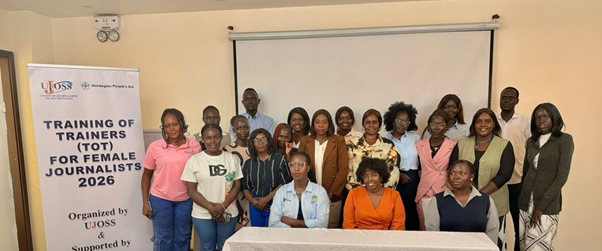
The Union of Journalists of South Sudan (UJOSS) has called upon female journalists to leverage professional training opportunities and assume roles as trainers and mentors, thereby fostering the development of the country’s next generation of media professionals.
This appeal was made during a “female journalists’ training-of-trainers” program, supported by Norwegian People’s Aid (NPA). UJOSS encouraged experienced journalists, particularly women, to utilize their knowledge and professional experience to address the increasing demand for female trainers within South Sudan’s media sector.
Mr. Patrick Oyet, President of the Union of Journalists of South Sudan, emphasized the growing need for female trainers in the media sector, urging female journalists to seize these opportunities.
“We are conducting this training because we have identified a need for trainers, especially female trainers,” he stated.
Oyet described the training as a crucial transition for journalists who have accumulated years of professional skills and are now expected to impart their knowledge to younger colleagues.
He drew a parallel to career progression in a newsroom, where a journalist can advance from a junior reporter to a senior reporter, copy editor, editor, and ultimately, newsroom leadership.
“You cannot join as a junior reporter and remain there forever. You have to grow,” he remarked.
He encouraged participants to view training others as an integral part of their professional growth and their contribution to the media industry.
Oyet noted that South Sudan’s media sector had historically relied heavily on journalists and trainers from neighboring countries for professional development.
However, he observed a growing number of South Sudanese journalists acquiring the necessary skills to conduct training themselves.
“We have seen a real transition,” he said, adding that the union was creating opportunities for trained journalists to apply their skills beyond their own newsrooms.
According to Oyet, some trained journalists have already been engaged to support journalism clubs in schools, participate in panel discussions, and conduct training activities for fellow journalists in various states.
He further mentioned that the union had also facilitated opportunities for some journalists to travel with teams to conduct training for colleagues outside their usual areas of work.
Despite these expanding opportunities, Oyet expressed concern over some journalists withdrawing from training assignments at the last minute or failing to communicate with organizers.
He explained that such actions create difficulties for organizers, who are sometimes compelled to find urgent replacements.
“The opportunities are there, and when they are given, you should really take them seriously,” he advised.
Oyet also underscored the importance of preparing a new generation of media professionals to assume leadership responsibilities in the future.
He asserted that journalists seeking career advancement should not only acquire technical skills but also gain experience working within institutions and understand the operational dynamics of media organizations.
“All of us here, one time, we leave the position we are in, and we need people to come and take over,” he said.
He characterized professional development as a continuous cycle where experienced journalists eventually transfer responsibilities to prepared colleagues.
He extended gratitude to Norwegian People’s Aid for their support of the training and other initiatives aimed at strengthening South Sudan’s media sector.
He highlighted the significance of capacity-building programs in helping journalists develop existing skills and guiding them towards greater professional responsibilities.
The training commenced with a call for participants to apply the knowledge gained and emerge as mentors, trainers, and future leaders within South Sudan’s media industry.
Join the conversation
Keep contributions respectful, relevant and suitable for a public newsroom.