
By Awan Achiek
The Ministry of Water Resources and Irrigation has announced plans to expand access to safe drinking water in Juba. A proposed second phase of the Lologo Water Treatment Project is expected to benefit more than 500,000 residents through the construction of a new central water treatment plant.
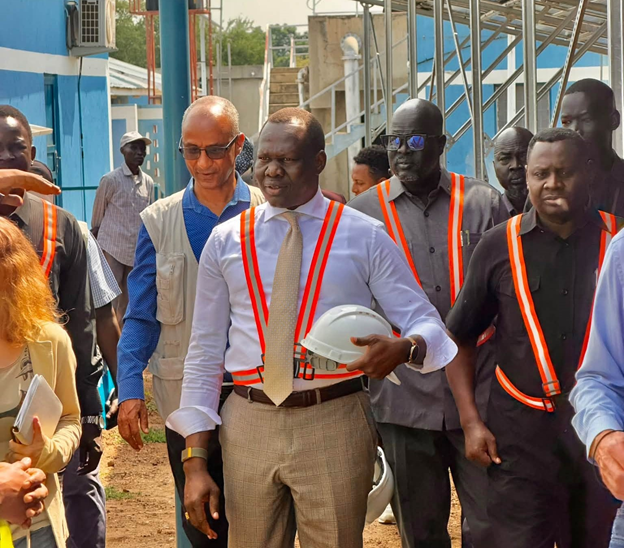
This announcement follows a joint technical inspection of the Lologo Water Treatment Plant on November 9, led by Sultan Lam Tungwar Kueigwong, Undersecretary at the Ministry of Water Resources and Irrigation.
The inspection team included Joseph Dut Kuoi, General Manager of the South Sudan Urban Water Corporation (SSUWC); officials from the German Embassy; representatives from UNICEF; and senior technical staff from the ministry.
According to Tungwar, the team assessed the plant’s operational capacity and its ability to extend services to additional neighborhoods, including Jondoru, Protection of Civilians (POC) sites 1, 2, and 3, and Munuki.
He noted that the inspection focused on the plant’s power supply, water treatment capacity, raw water intake, and the condition of its primary and secondary distribution networks.
“Phase One: Operationalization of the Lologo Water Connectivity System currently serves over 200,000 people in southern and central Juba,” Lam stated in a Facebook post on Monday.
“Phase Two: Construction and operationalization of the Juba Central Water Treatment Plant is designed to serve over 500,000 people and close the supply gap in the northern and western corridors of the city.”
Lam explained that the Lologo Water Treatment Plant currently supplies more than 200,000 people in southern and central Juba under the first phase of the Juba City Water Connectivity Plan.
He described the second phase as involving the construction and operationalization of the Juba Central Water Treatment Plant, which aims to serve more than 500,000 people and address water supply shortages in the northern and western parts of the city.
“Juba cannot sustain water services through humanitarian, off-budget financing. The strategy requires a gradual shift towards statutory budget lines for the Ministry of Water Resources and Irrigation, transparent tariff and cost-recovery frameworks for urban utilities, and the leveraging of climate adaptation and infrastructure funds,” Lam stated.
He emphasized that the expansion is part of the broader Presidential Compact on Water, Sanitation, and Hygiene signed in June 2024, which seeks to transition the country from fragmented, project-based interventions to a government-led expansion of safe water services.
The government also intends to shift urban water services from humanitarian and off-budget financing to statutory government budget allocations, transparent water tariffs, and cost-recovery mechanisms.
“A water treatment plant is only as reliable as its energy supply and distribution network. We examined raw water intake, treatment capacity, power backup systems, and the integrity of the primary and secondary distribution lines.”
During the inspection, Lam also met with community leaders from Jondoru, the three POC sites, and Munuki, urging residents to protect water infrastructure against vandalism and illegal connections.
Join the conversation
Keep contributions respectful, relevant and suitable for a public newsroom.